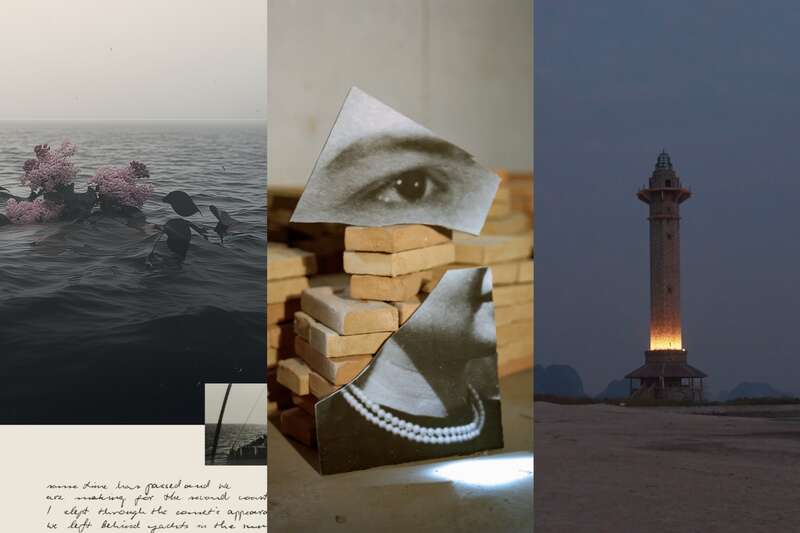
Seafaring Traces: Fragments of Fathers
Kasia Molga, Katalin Száraz Davies, and Ioanna Sakellaraki in conversation
In this conversation, Kasia, Ioanna and Katalin discuss their photographic practices in relation to the maritime traces left by their fathers: materials that move among logbooks, letters, photographs, diaries, and objects, hovering between document and residue. Each artist works with fragments of these lives at sea. You can view their artistic interventions here, here and here, alongside this dialogue, moving back and forth.
Our conversation starts with the specificity of seafaring labour: a working life structured by long absences, contracts at sea, and repeated departures and returns. For their families, this meant that fatherhood was often lived at a distance, shaped by rotation rather than continuity, leaving behind traces that had to be pieced together later.
What interested me in exploring with them is how these traces entered their practicies and began to circulate between lived experience and reconstruction. Their fathers appear at different proximities: experienced directly within the rhythm of maritime life, encountered later through a fractured posthumous archive, or approached indirectly through inherited objects and stories that point elsewhere.
Across these positions, photography appears as a recurring point of contact with these materials—handled, revisited, and reworked within each practice—shaped by the same instability that runs through the archives themselves.
Elena Musetti
09 okt 2026 • 10 min
All three of your artistic practices have been brought to the open ocean in different ways, both symbolically and quite literally. This doesn’t seem like a random choice but something deeply rooted in your personal histories and the shared experience of growing up with fathers at sea. They took photographs, collected objects, wrote letters, and kept logs. Even if these gestures were never intended as artistic acts, they now form archives. What do you think your fathers were trying to preserve? And at what point did these personal traces become artistic material for you?
Kasia Molga: For me, it’s impossible to understand my father’s urge to document without taking into account the political and historical circumstances that shaped his life. He became a sailor partly as a form of escapism, a flight from the trauma he’d experienced as a child during World War II. The sea offered him a way to leave a landscape of violence behind and understand the world outside.
His journals functioned on different levels: They were memoirs for the family—my mother, his siblings, and myself—but also a dialogue with himself. Alongside meticulous observations of weather, currents, and the colour of the water, he reflected on his childhood and searched for meaning in what had happened to him. Perhaps sailors become so attentive to these details because they offer a sense of orientation within the uncertainty of the ocean.
I literally grew up on those ships, travelled with him, and watched him take photographs. It was only after his death that these materials came alive for me. My first instinct was to reopen those notebooks and touch the shells he’d brought back as an attempt to hold onto his presence a little longer. The photographs may not have been art to him, but to me, they carry his soul; as Douglas Hofstadter writes in I Am a Strange Loop,Douglas R. Hofstadter, I Am a Strange Loop (Basic Books, 2007). traces of a person’s consciousness can survive in their creative artifacts.
Ioanna Sakellaraki: My experience was almost the opposite. Discovered after his death, my father’s archive revealed something none of us knew: another family, another child, a parallel life playing out in Piraeus. As a child, in our house in Greece, I knew of a specific cabinet that belonged to him, but it was a private space I never allowed myself to look into. I now realise he kept these materials almost obsessively as if to guarantee that this other world wouldn’t disappear. I wonder if he meant for us to find them as a way of narrating his secret after he was gone. Unlike relatable family photographs, this archive doesn’t trigger familiar memories; it functions as a tool for witnessing an entirely unknown history of unfamiliar people and places.
Katalin Száraz Davies: I recognise that feeling of an archive that was always there but only became readable later. I was born in 1988, on the eve of the dissolution of the Soviet Union and the subsequent collapse of Hungarian shipping, so unlike my mother, I never had the chance to travel with my father. My first access to his world came through the stories they shared with me and the letters my parents exchanged, bridging the distance between presence and absence. Eventually, I realised I’d been living alongside another archive. Growing up, I played with the objects my father brought home from distant ports—coins, shells, masks, and statues stored in a large glass armoire. These were simply part of my everyday life. When something is always right in front of you, you don’t see it as special at first. Only through this project did the letters and objects begin to reveal new meanings, quietly reshaping both my memories and myself.
We often imagine archives as stable, ordered systems. Yet, in your work, the archive seems profoundly oceanic—tidal, incomplete, and refractive. It behaves less like a static repository and more like an active force that demands constant imagination and reconstruction. How does this instability shape your artistic process?
Ioanna Sakellaraki: For me, the fragment is the entire method. I no longer see fragments as remnants that connect us exclusively to the past; through their omissions, they point to the future by forcing us to speculate on what could be. My research was profoundly influenced by Maurice Blanchot’s writing on fragmentation—the idea that a fragment is not a ‘failed whole’ but a dynamic opening that remains incomplete and constantly produces new associations.The understanding of the fragment as an open, non-totalising form resonates with Maurice Blanchot’s reflections on fragmentary writing, particularly in The Infinite Conversation, trans. Susan Hanson (University of Minnesota Press, 1993), and The Writing of the Disaster, trans. Ann Smock (University of Nebraska Press, 1995).
In my work, photography functions not to organise material into a coherent narrative but rather to disorient us within the archive. The fragment has become my sole co-ordinate; it allows me to enter these spaces not as a journalist or archivist but as an artist with the freedom to dismantle and rearrange. This approach enabled me to move beyond autobiography towards broader collective histories. It led me to the pearl—a metaphor for an object that travels between oceans, histories, and legacies, linking the Mediterranean to the Pacific in a labyrinthine loop of discovery.
Kasia Molga: That instability is precisely what the ocean teaches us: everything’s present, but nothing is fixed. The sea absorbs sediments, wreckage, and memories, and it redistributes them elsewhere. My father’s photographs of horizons and clouds are universal; their specificity almost disappears; they could’ve been taken anywhere.
In my project How to Find the Soul of the Sailor, I use these five hundred photos as a dataset for AI systems, combined with climate models to generate images of future oceans fifty years from now, a hundred years from their original dates. I call it a speculative séance. It’s not about reconstructing exactly who he was but about perpetuating his sensitivity and concern for the marine environment in a future he could never have imagined. It’s a navigation between memory and responsibility.
Katalin Száraz Davies: What touches me most about that comparison between the archive and the ocean is its vulnerability. There are always missing pieces, submerged parts that remain inaccessible. There has always been a lingering feeling in me during the process, as if something were still missing, as if I hadn’t yet read and discovered something important from my parents’ correspondence, parts of which have also been lost over the years. This sense of absence reminds me that an oceanic archive is never a complete body waiting to be assembled but something that’s at once an obstacle and a framework.
I usually work in a very controlled way: I like to plan every detail in advance, to construct images carefully before I make them. However, the archive can become suffocating; sometimes, I need distance in order to return to it. The sea, in that sense, forced another rhythm onto my practice. Creating on the way, in motion, taught me to loosen that control and to trust intuition.
Let’s turn to photography. Traditionally associated with evidence and clarity, in your work it seems instead to become a way of navigating what can’t be fully recovered. Has this way of working changed your understanding of the image? And through that process, has it also changed the way you see your father—or yourself?
Katalin Száraz Davies: For me, the photographs weren’t primarily about documenting what was already there but about discovering and reconstructing what first existed only in my imagination. As the project developed, however, that romanticised vision began to collide with reality. By photographing industrial ports and rusting infrastructure, I wanted to make people question idealised views of seafaring life, and I intended to show its duality.
The project also led me to self-discovery. I only later realised that, as a child, there was always a question beneath the surface—‘What if he never comes back?’ This anxiety has shaped the way I relate to absence and return in my life. At the same time, I inherited my father’s restlessness and now find that I’m the one who’s constantly leaving. In this sense, photography allowed me to see both him and myself more clearly while also creating a space for sharing and connection between us.
Ioanna Sakellaraki: Facing this project, I’ve sought to unlearn my father, beginning from what I don’t know and embracing that uncertainty. I resonate with the idea of learning about myself while discovering him through these fragments. Tied to him by a shared fascination for an adventurous life, I now occupy the other side of that distance. Only by experiencing it myself have I begun to imagine the loneliness and isolation that accompanied his journeys. While he presented as a proud man who lived many lives, the archive also reveals a more fragile reality he kept guarded: the failures of his marriages and a child from whom he remained emotionally distant.
I define my practice as hybrid photography because the work rarely ends with the image itself; it’s a way of keeping the space open for new connections. By stepping outside the archive, I invite interpretations I could never have anticipated. At the same time, involving my family in the construction of the images created a moment of resolution when we could finally speak about what otherwise would’ve remained unspoken.
Kasia Molga: I don’t consider myself a photographer. Rather than making photographs, I worked with my father’s images as a dataset, using them to train an algorithm capable of imagining future oceans through his perspective. I follow his routes and let his images drift towards futures that transcend us both.
Perhaps because we understood each other without speaking, I now find myself negotiating a difficult question: How can I reveal his emotional world without betraying the privacy he carefully preserved? Every interpretation is inevitably my own and this inherent uncertainty is what keeps the archive alive. Ultimately, How to Find the Soul of the Sailor is an invitation to inhabit the navigator’s gaze. It’s a bridge between his humanity and our shared climate future, and it urges us to consider the legacy we’re leaving for the generations that will inherit these shifting waters.
Listening to you now, inherited materials from your fathers at sea no longer seem to ask for completion or explanation but for different ways of staying with them.
Ioanna Sakellaraki: I used to think I was trying to complete something that was missing. Not anymore. Even cutting and rearranging has become quieter for me, less about explaining anything. Sometimes I feel I’m just staying close to something I’ll never fully enter. And somehow, that feels like enough.
Kasia Molga: I find myself returning less to what my father wanted to preserve and more to the act of looking itself. The photographs are no longer things I try to interpret or resolve. They just sit there with me in the studio, like weather changing slowly in the background. I don’t really need to finish them for them to matter.
Katalin Száraz Davies: Yes, for a while I kept discovering more and more objects and letters, and I incorporated them into the project. But at some point, I began to feel that I wanted closure rather than further expansion, and I wanted to carry with me what I’d learned about myself and my family through the years of building this work and creating some distance with it.
This online contribution is part of Trigger #7: Ocean, the wider project accompanying the printed book published by FOMU and Fw:Books. Extending the book beyond its printed pages, the online series follows further conversations, works and perspectives that explore the ocean as an environment, a force and a way of thinking with images. Each contribution takes its own route through these questions.