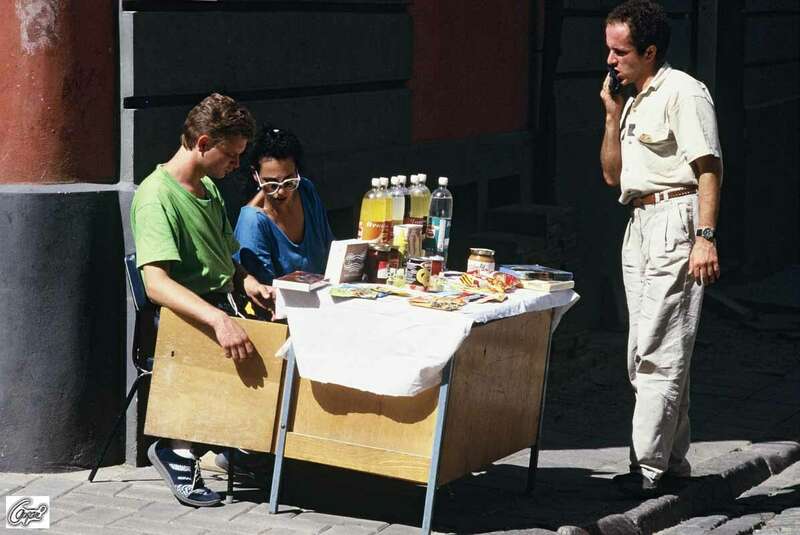
In this article, I reflect on my own project, the Instagram account @90s_lithuania - Lithuanian Visual Culture Archive, which I began in 2017 as a way of collecting and re-presenting visual artefacts from Lithuania’s early independence period. To situate it within a broader Baltic perspective, I place it into dialogue with two other independent Instagram pages: @90s_latvia and @eesti_90ndad, which focus respectively on Latvian and Estonian visual culture of the 1990s and early 2000s. Although these accounts emerged separately, their very existence raises questions of why the transitional period of the 1990s and early 2000s provokes nostalgia for countries that have gone through a radical transformation during that period. How can the past be reconstructed and reflected on social media?
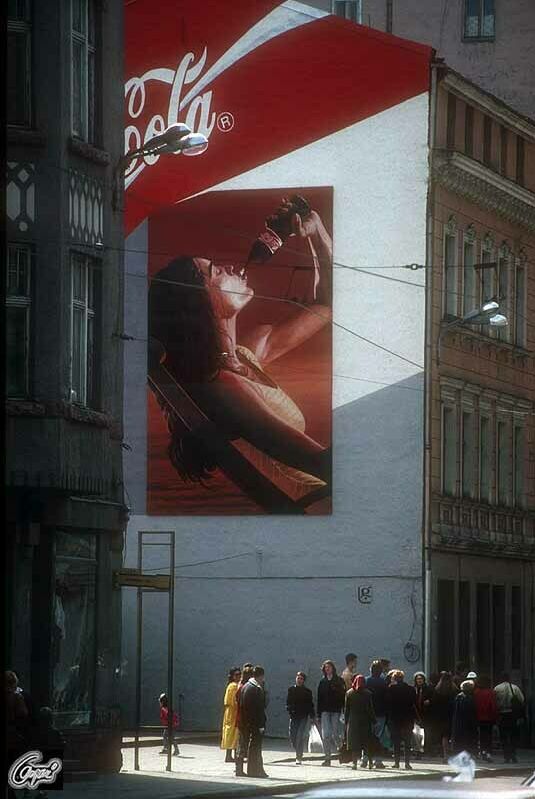
Albert Caspari, 1993, Riga, Latvia.
The years 1990 to 2004 in the Baltic states and across Central and Eastern Europe were defined by a state of transition: the collapse of socialism and communism, the emergence of independent nation-states, and the accelerated embrace of capitalism. This time is often described as the post-soviet era. Yet I avoid this terminology, as it implicitly binds a country’s trajectory to the soviet past - a past that was not self-chosen. That’s why I prefer to think of it as an early independence period or a spacetime ‘in-between’ – between the soviet union and the European Union, when the past had not yet faded away but the future was envisioned with hope and excitement.
This in-betweenness was marked by political and economic changes reflected in visual culture. Alex, the curator of @90s_latvia, metaphorically compares the visual shift of the 1990s to the start of heavy rain:
First drops, and kiosks appeared. . .Then the drops started falling more frequently, rows of kiosks appeared, the trade spilled from markets onto the streets, advertisements coloured building walls, liqueurs of different colours were sold on the street just on cardboard near the train station. The city was boiling. Streams flowed through the streets sweeping everything along.
The free trade economy rapidly entered reality and made a direct impact on the urban landscape of the 1990s in the Baltic region.
The rapid ideological shift of the 1990s drastically changed visual reality. Two curators of @eesti_90ndad (who choose to stay anonymous) note that ‘you can often pinpoint the exact year a photo or video was taken just by its style. For example, in a photo from 1993 you might still see plenty of soviet cars and clothing. Even street name signs written in Cyrillic. Fast forward just three to five years, and western cars were dominating, clothing looked more modern, and the streets had gained far more variety and colour’. The visual reality surrounding people every day became carriers of the confrontation between old and new ideology. It was a visible shift from the aesthetics of ideological realism to the free-spirit glossiness of consumer capitalism. @90s_latvia’s curator, who was born in the late ’70s, witnessed it with his own eyes:
Perhaps when you are fifteen, any time will seem vivid, but I remember very well the contrast when the wave of change washed away the darkness (literal and in terms of visual image) of the ’80s and brought explosions (sometimes literally as well) of colours, forms, and symbols in the early ’90s.
Three decades later, in 2025, in the midst of technological acceleration, wars and political controversies, climate change and overall instability both local and global, the recent past is being romanticised as a safe space. In the 1990s and 2000s, digital technology was a desirable object bringing hope; the integration into the European economic environment indicated progression; the global entertainment culture found its place in people’s homes and minds. For Lithuania, Latvia, and Estonia this time meant the reestablishment of status on the global stage, bringing a promising vision for the future.
Nostalgia for the ’90s started to emerge between 2009 and 2012 in independent blogs and niche forums and communities. In 2009, I was a member of one such Facebook group, ‘I am a 90s child!’ (‘Aš esu 90-ųjų vaikas!’), which gathered around 100 people at the time. Users uploaded images that evoked memories of their own lives, while others responded with reminiscences in the comments. Interestingly, this nostalgia for the ’90s emerged in the midst of economic recession, indicating a complicated relationship with the present time. Even though I was only 11 years old at the time and didn’t really understand what was happening in the world, this group was the beginning of my engagement with an audience through images of the past.
During my teenage years, in the mid-2010s, I became acutely aware of how everyday visual culture was changing around me. Shop signs, product packaging, and other familiar artefacts of the 1990s and early 2000s were gradually replaced by contemporary rebranded versions. I noticed, for example, how the Dirol chewing gum logo lost the bulky, upright, 3D appearance that defined it in the ’90s and transformed into a sleek italic look of the 2010s. Such details revealed to me a quiet but undeniable truth: time leaves visual traces, and the world I grew up in would never return.

Chewing gum ‘Dirol’ packaging from mid-90s.
Led by this understanding, in April 2017, I created the Instagram account @90s_lithuania to collect and reflect on the visual culture of 1990 to 2004, the years between Lithuania’s regained independence and its entry into the European Union.
In May 2017, two students from Estonia created their own nostalgic project, @eesti_90ndas (Estonian ’90s). Like mine, it emerged from their personal interests and sense of nostalgia:
In the beginning, we basically posted every photo we could find, and this approach quickly drew attention and raised our following. Today, we take a more deliberate approach, carefully selecting which photos and stories to share.
I’m wondering, what photos do they want to be seen and stories to be told? People send them pictures of their everyday Estonian lives in the ’90s, which is exactly what @eesti_90ndad is looking for:
We are looking for a candid view of the ’90s life. One of the most memorable submissions we’ve received is a photo of a man posing in front of his white BMW E30.
This raises a questions: are success stories of becoming Western - the main object of Baltic nostalgia?
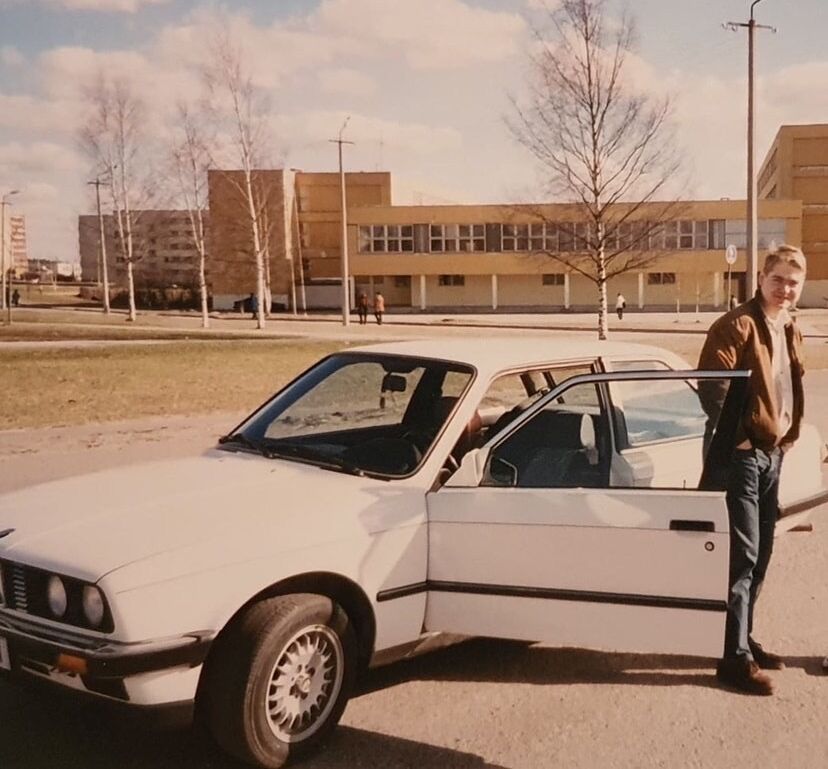
Marko Käsi, Late 90s, Tartu, Estonia.
@90s_latvia curator Alex is also searching for photos and videos that reflect simple, everyday life:
I like them more than photos of events. Shop signs, or just streets, shops with prices, advertising at bus stops… oh it’s wonderful! Is there reality in them? Without doubt. Is there an imitation and playing of the West? Absolutely.
These three Instagram accounts share a similar type of content – photographs of everyday life, where commercial or technological signs are encoded. But the more I reflect on the photos, the more I see that what evokes nostalgia in Lithuanians, Latvians, and Estonians are the images that capture our trials of becoming Western. Mark Fisher’s ‘hauntology’ describes a culture haunted by the ghosts of ‘unfulfilled futures’ – lost possibilities for a better world that were promised but never fully materialised. Fisher refers to these spectres of futures that never came to be as ‘Ghosts of Futures Past’.Mark Fisher, Ghosts of My Life: Writings on Depression, Hauntology and Lost Futures (Winchester: Zero Books, 2014), 16. In the case of Baltic countries, these nostalgic images present consumerism and Western culture as an exemplary and aspirational standard of life. Now, in 2025, we can critically reflect on these images from our present-day position within capitalist realism – another term coined by Fisher to refer to a widespread ideological condition in which capitalism is perceived not only as the dominant economic system but as the only viable one.Mark Fisher, Capitalist Realism: Is There No Alternative? (Winchester: Zero Books, 2009), 2. ‘Today’ is supposed to be the once-promised future, but instead our culture becomes nostalgic, cancelling any vision of the future – capitalism became a machine reproducing its own imagery.
When I remember growing up in the early 2000s in Vilnius, Lithuania, a flow of images that fulfil the capitalist prophecy arise in front of my eyes. Nokia phones were connecting people, the smell of Jacobs Krönung coffee was inviting in homes, McDonald’s was a restaurant for special occasions… These and many other ‘imported’ realities from the West depicted in the advertisements of the 1990s to the 2000s formed my worldview. I’m not the only one who feels nostalgia for these promised futures. In 2019, for example, Lithuanian artist Donatas Stankevičius started a series ‘Legendary Past’, a project that became his master’s thesis. We met when I was invited as a ‘’90s specialist’ to his master’s graduation show at Kaunas Photography Gallery in 2023, where he explained his artistic motives. Stankevičius reconstructs mundane memories that weren’t photographed when he was a child or a teenager.
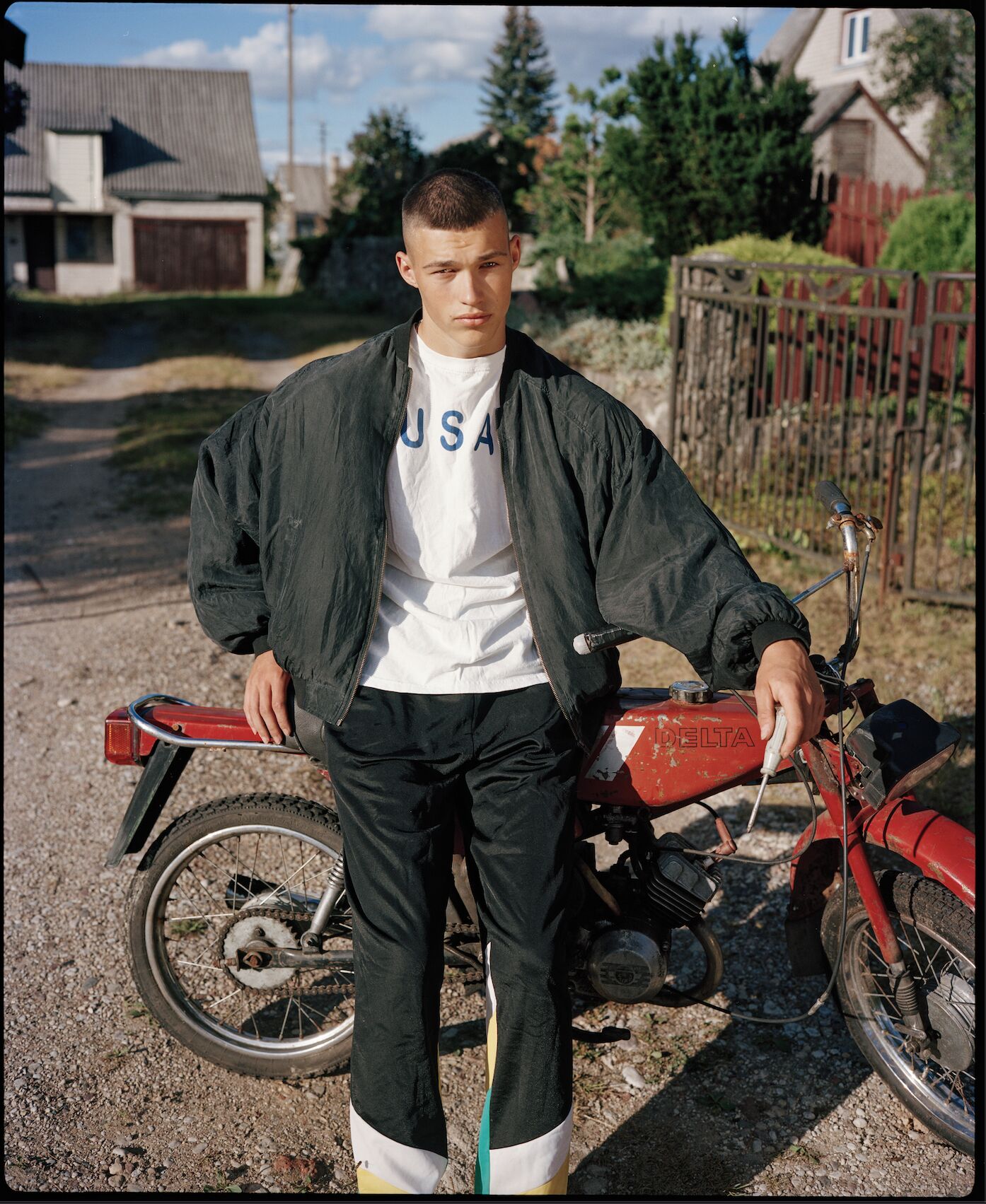
Donatas Stankevičius, From the series ‘Legendary Past’, 2023, Lithuania.
Later, in 2024, Stankevičius and I both participated in the project ‘La saison de la Lituanie en France’ – a series of exhibitions of historical and contemporary Lithuanian photography – in Amiens and Berck, France, where I had a chance to better get to know his creative inspirations. He kept reminiscing about specific details from the last decade of the twentieth century – video games, ‘Turbo’ chewing gum he bought at kiosks, a poster of an NBA player hung on a bedroom wall. For him, photography is an extension of memories. In my opinion, he points to a very special memory of our generation – Western commercial culture, where brands, logos and celebrities are a huge part of the ‘legend’ of the past.
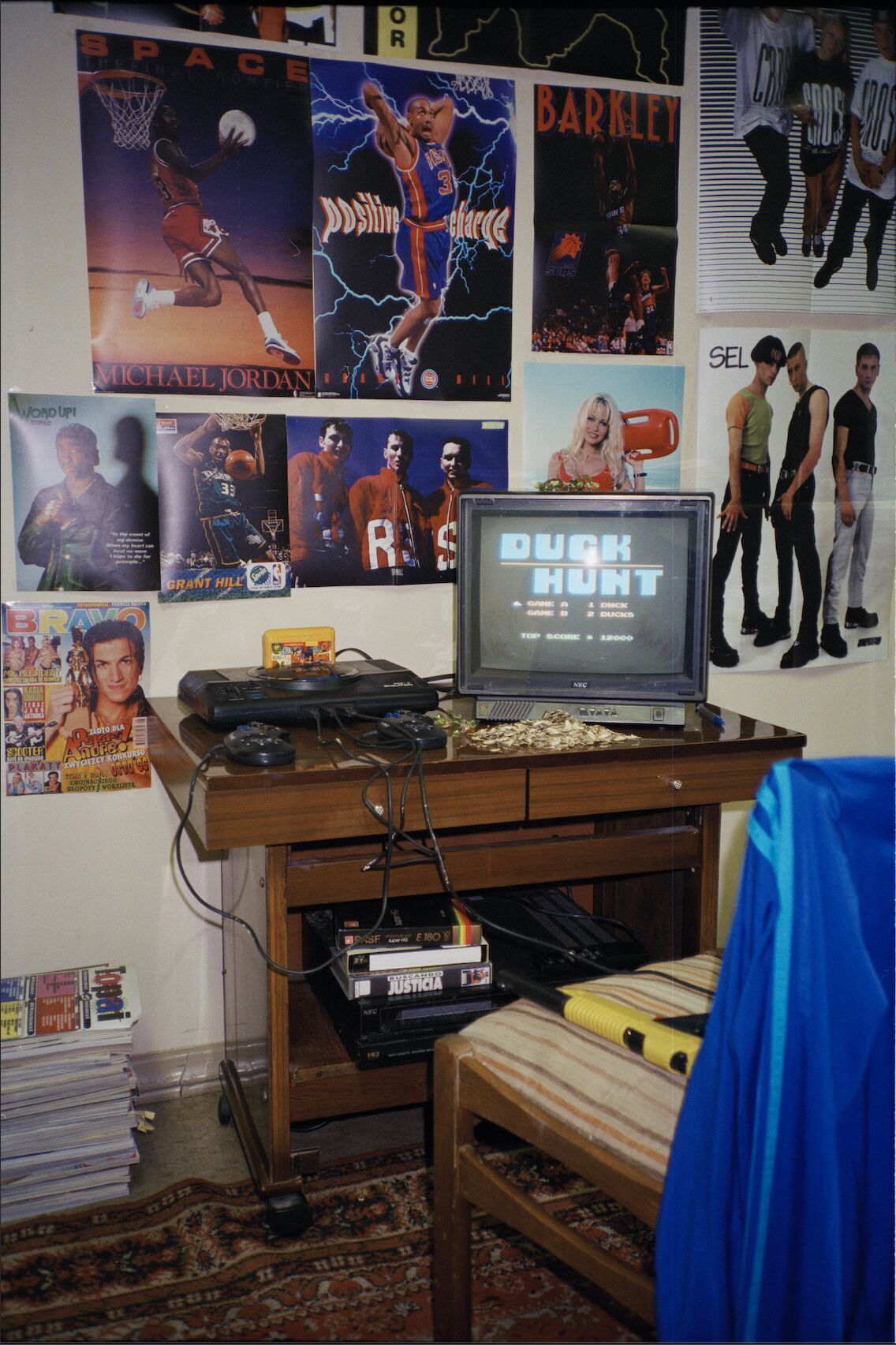
Donatas Stankevičius, From the series ‘Legendary Past’, 2023, Lithuania.
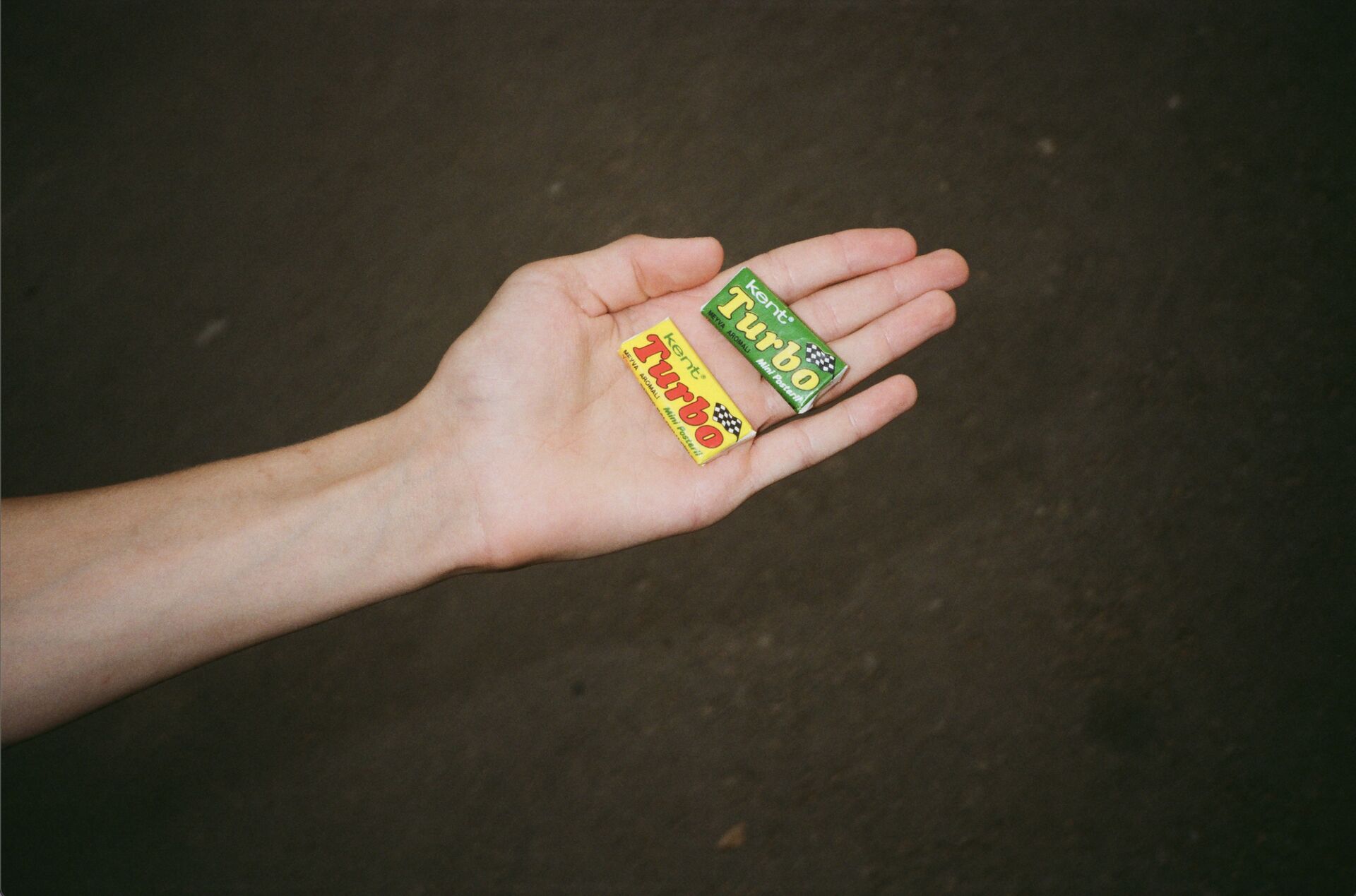
Donatas Stankevičius, From the series ‘Legendary Past’, 2023, Lithuania.
During the 1990s and early 2000s in the Baltics, commercial imagery emerged as an integral part of capitalist mechanics. Often visually experimental and unconventional compared to the ideological advertisements of soviet times, these images crystallised new social values and aspirations. In his article ‘Rhetoric of the Image’, Roland Barthes describes his method of dissecting denotation and connotation in advertisements: denotation is literal meaning (in Barthes’ example, boxes of Panzani pasta and vegetables in a net bag), while connotation is the cultural, historical, or emotional meaning of the objects in the image (in this case, for instance, Italianicity). Denotation and connotation form the rhetoric of the image – the grammar of visual persuasion.Roland Barthes, ‘Rhetoric of the Image’, in Image-Music-Text, trans. Stephen Heath (Hill and Wang, 1977), 32. In advertising, denotation can be used to mask connotation – one of the manipulative qualities of advertising that makes ideology look like common sense.
The shift from socialist realism to capitalist fantasy is particularly visible in a Lithuanian advertisement for the clothing store Aprangos galerija (‘Clothing Gallery’) published in the magazine Stilius in 2000. The photograph shows a playful young couple in brightly coloured clothes: the woman jumps onto the man’s back as he flashes a peace sign borrowed from Western pop culture. Behind them is a black-and-white photograph of weary soviet citizens, set against the Lazdynai residential skyline in Vilnius. The juxtaposition is sharp: the contemporary couple laughs freely, their gesture aimed toward the ‘oppressed’ figures of the past. The young people resist the history with light heart because the text says ‘for those who live their own way’. A person in soviet commercial photography was typically reduced to a social class – the hard-working proletariat whose individuality is not the focus. The denotation of two young people neutralises the complexity of history and takes the ‘Western way of living’ as self-evident. This particular commercial image stages a clash between two temporalities – the exhaustion of late socialism and the vitality of new capitalism – transforming the image into an aestheticised commentary on society’s mood at the beginning of the new millennium and adaptation of Western mentality through consumer goods.
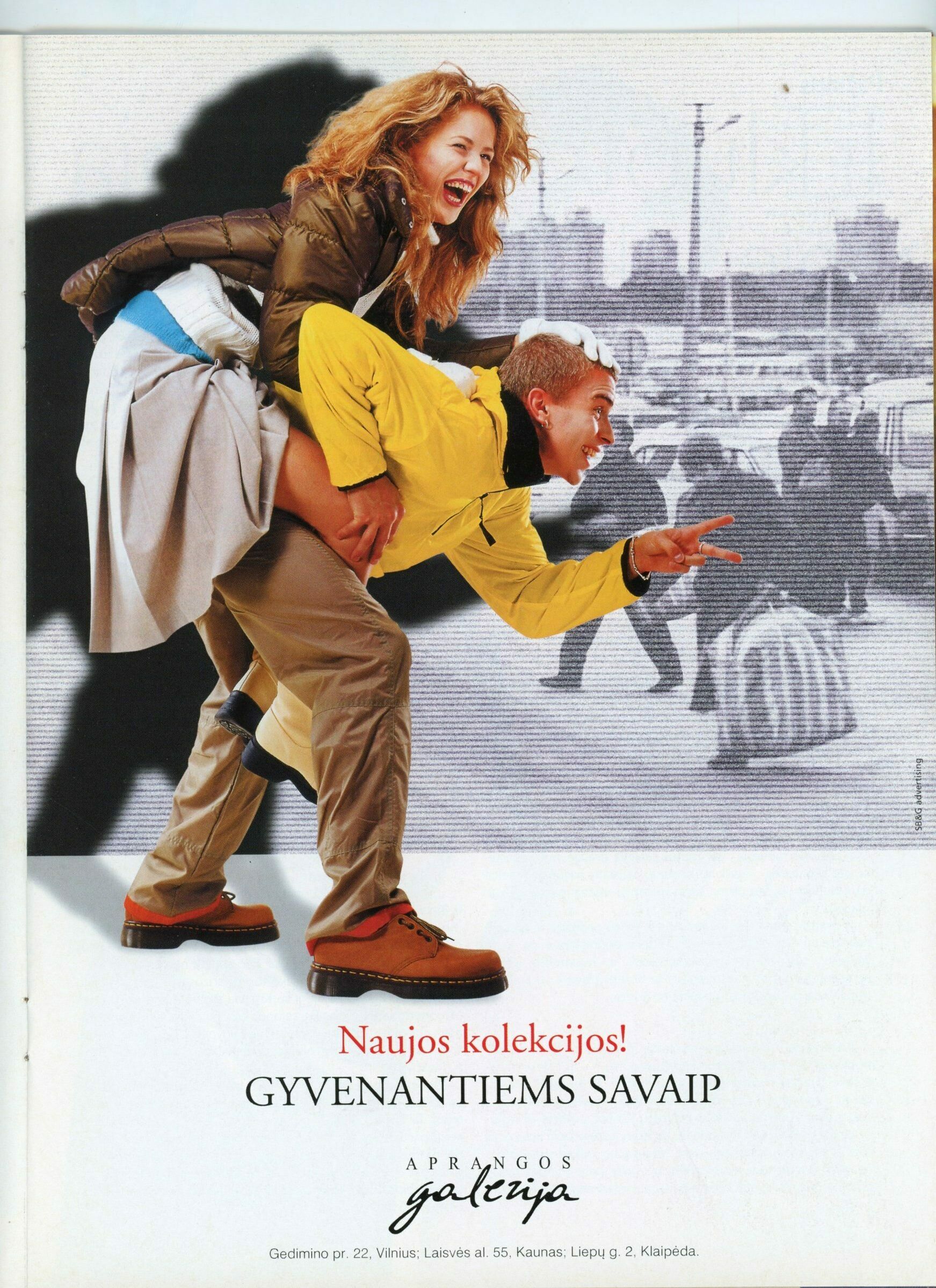
Lithuanian clothing shop ‘Aprangos galerija’ (‘Clothing Gallery’) ad in magazine ‘Stilius’, November issue, 2000. Postscript: ‘New collections! For those who live their own way’.
The content on @90s_latvia, @eesti_90ndad and @90s_lithuania can seem like we’re engaging in historical re-enactments, with photographs serving as the building blocks for virtual nostalgic space, reminding us of past fantasies and realities. However, in the comment sections, we encounter long threads of people’s personal memories. For example, on a post about the time aerobatic pilot Jurgis Kairys flew upside down under the Simonas Daukantas Bridge in Kaunas, Lithuania, followers remember how exciting it was to spot Finnish Formula One racing driver Mika Häkkinen in the audience and remark that nowadays the municipality wouldn’t give permission for an aircraft to fly under a bridge on which a crowd is standing. The social media environment facilitates both re-enactment and meditation on the link between past and present. Its networked nature makes it a collective project, allowing room for both the subjective and collective experiences of individuals who witnessed these events. It’s both the reflective and restorative modes.
In her book Future of Nostalgia, Svetlana Boym explains her theory of restorative and reflective nostalgia: two modes of longing that shape our relationship with the past. Restorative nostalgia aims to do precisely that – to restore, rebuild, reconstruct, and bring back the lost original world of the past, which is better than the present one. It’s traditionally attributed to religious and ideological projects.Svetlana Boym, The Future of Nostalgia (New York: Basic Books, 2001), 41. As the three Instagram accounts – @90s_lithuania, @90s_latvia, and @eesti_90ndad – are national initiatives, we can suppose that their aim is the reconstruction of the ‘legendary’ transformational early independence period. Photography serves as the material for the reconstruction of the past in the virtual space – an escapism from present reality. Meanwhile, reflective nostalgia, as defined by Boym, is a state of longing, mourning, and ‘mediation on history and passage of time’Boym, 49. – all the things that are happening when audiences engage with nostalgia-inducing historical materials by using interactive tools as they comment, like, repost, and share.
Lithuanian sociologist Lina Birškytė distinguishes between modern and post-modern forms of nostalgia. She argues that modern nostalgia involves a deeply emotional longing for the past, rooted in disillusionment with the present and scepticism toward progress. By contrast, post-modern nostalgia, emerging in a mediated, consumerist culture, is detached from sentimentality; images of the past are stylised, commodified, and circulated as cultural products.Lina Birškytė, ‘Nostalgija kaip sociologinio tyrimo objektas: problemos ir teorinės prieigos’ in Sociologija. Mintis ir veiksmas, 2016, 212–228. Similarly, media researcher Paul Grainge identifies the ‘nostalgia mood’ – an experiential, emotional state akin to modern nostalgia – and the ‘nostalgia mode’ – a consumable, stylistic form aligning with post-modern nostalgia.Paul Grainge, ‘Nostalgia and Style in Retro America: Moods, Modes, and Media Recycling’ in The Journal of American Culture, no. 1, 2000, 27–34. This distinction helps us understand contemporary nostalgia for the 1990s and 2000s on social media, where audiences celebrate past aesthetic styles that are re-appropriated and repackaged in the present. In this sense, current nostalgic trends exemplify post-modern nostalgia as a cultural style rather than a purely emotional experience.
Whereas modern nostalgia is often experienced through direct, material engagement with the past, such as traditional historical re-enactments in which people gather in period clothing to perform and reconstruct historical events, post-modern nostalgia increasingly unfolds in virtual spaces. On social media, the past becomes mediated: countless nostalgic images circulate as objects of consumption, reducing a complex history to decontextualized, stylised fragments. Yet these digital spaces can also serve as a form of escape from the present, and interactive tools allow users to reflect on and engage with the past. In this sense, nostalgia on social media oscillates between reconstruction and reflection (Boym), between modern sincerity and post-modern irony (Birškytė), and between mood and mode (Grainge).
Today, as Russia’s inflicted war on Ukraine challenges regional stability, the historical examples of the resistance of three Baltic states is more relevant than ever. The virtual re-enactment of history took place on 23 August 2025. It was the thirty-sixth anniversary of the Baltic Way, a peaceful political demonstration that occurred on 23 August 1989: a human chain of over two million people holding hands from Vilnius through Riga to Tallinn resisting the 23 August 1939 Molotov-Ribbentrop Pact, which laid the groundwork for the soviet occupation of the three countries. Participants were facing West and turned their back to East to show the world they no longer wanted to be part of the soviet regime. I decided to invite @90s_latvia and @eesti_90ndad to collaborate on the Instagram post, which features photographs of the event taken by Lithuanian, Latvian, and Estonian photographers. An Instagram carousel depicting individual people standing and holding hands zooms out to aerial photography showing the massive scale of the road. A sense of unity transcended more than three decades and was recreated in an Instagram post where people of the three Baltic states gathered virtually to share their memories, emotions, and pride. Compared with portraits of pop stars or commercial imagery, the success of this post suggests that visual representations of resistance against the soviet regime are what connect us as nations and as a region. This act of digital commemoration illustrates how social media has the potential to transform historical events into participatory memory practices, allowing nostalgia to serve as both connective tissue and cultural performance.
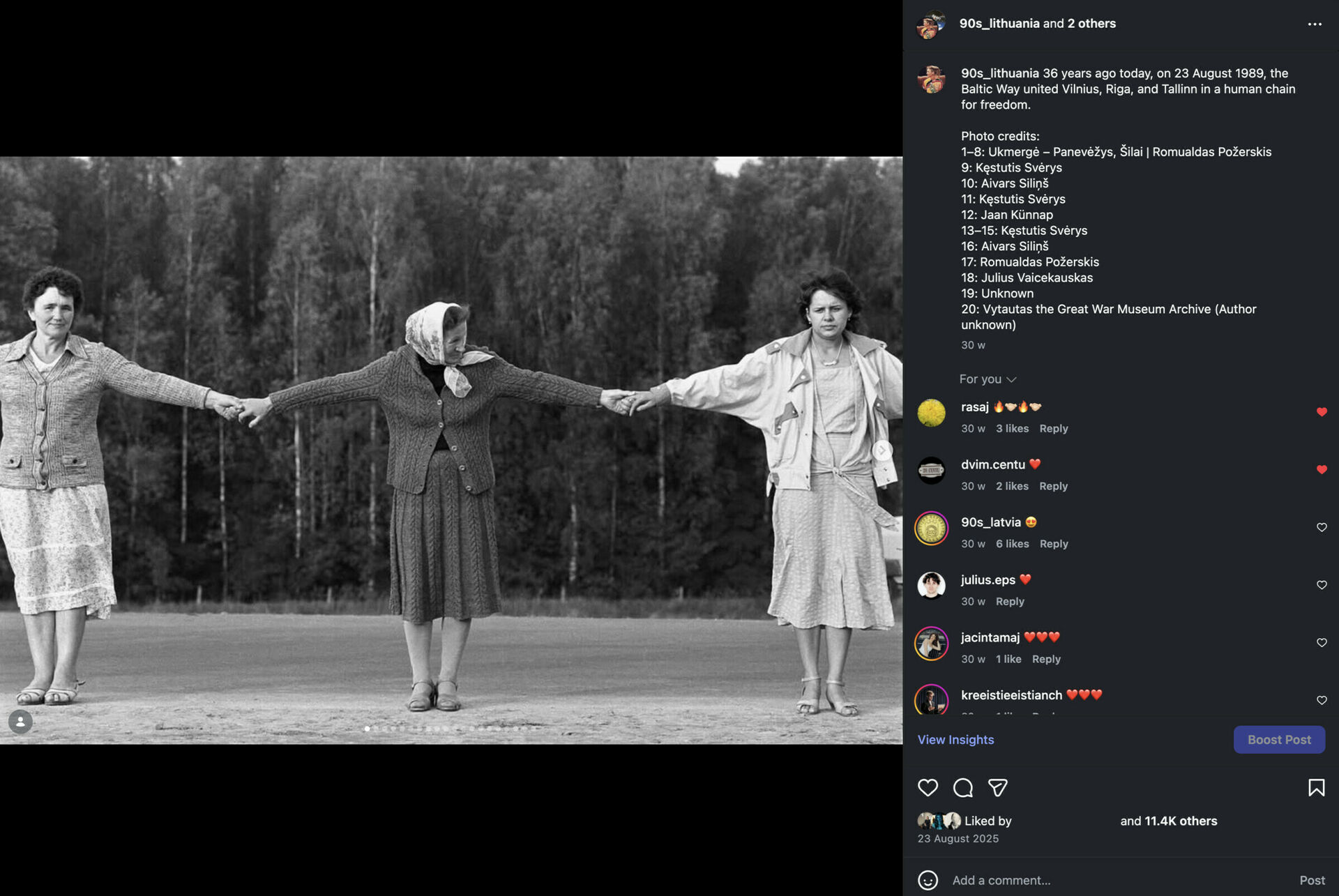
Instagram post, photographs taken by Lithuanian, Estonian, and Latvian photographers.

With collaborators @90s_latvia and @eesti_90ndad.
___
This article forms part of Networking the Audience, a themed online publication guest-edited by Will Boase and Andrea Stultiens, developed in collaboration with MAPS (Master of Photography & Society) at KABK The Hague. The contributions emerge from an open call shared across the MAPS network, including alumni, and bring together artistic and critical perspectives on photography, publishing, and circulation.
Together, the nine contributions reflect on how digital systems reshape authorship, readership, and meaning-making, foregrounding publishing itself as a creative and relational practice. Rather than addressing a fixed audience, the series explores how images and texts move through fluid, networked publics.