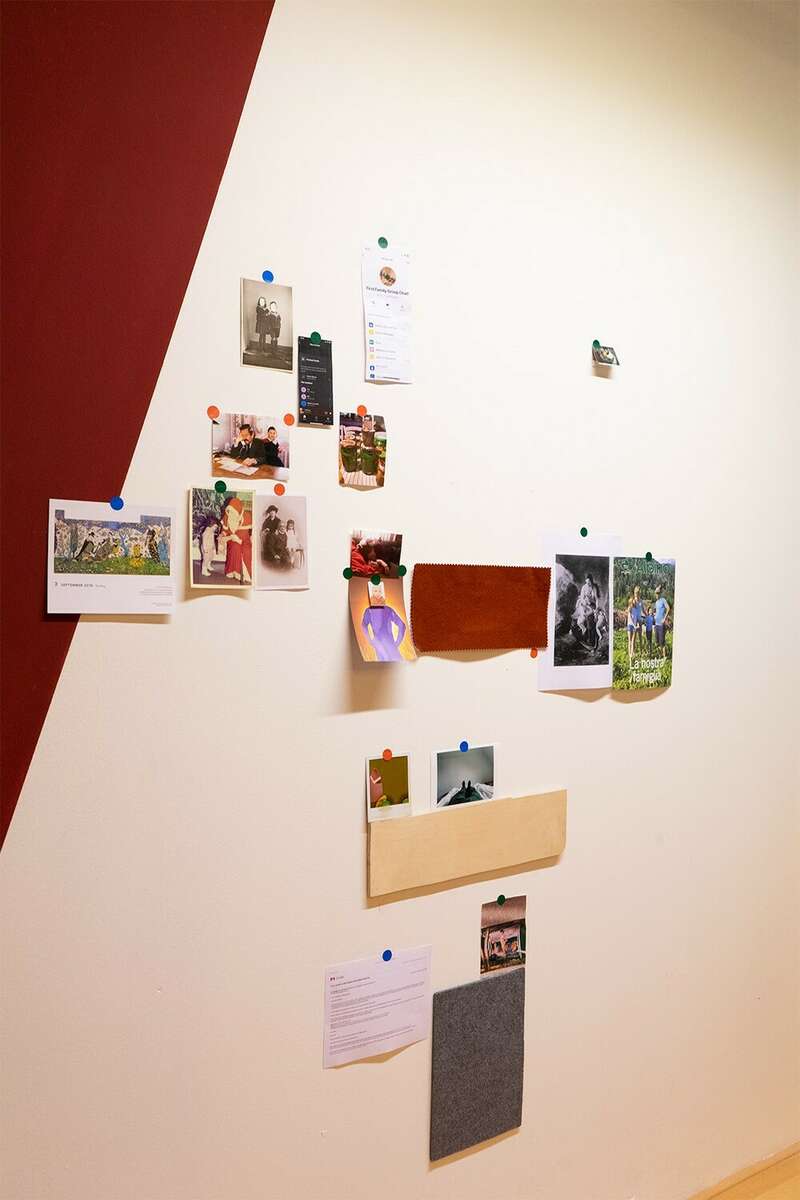
Investigating E/Iconomies: Family Assembly at Goethe Institut Rotterdam, curated by Dafni Melidou and Philipp Schwalb. Example of an image constellation.
Navigating (in) the algorithmic abyss
Collective strategies for seeing and understanding photographs today
A couple of years ago, a friend told me, in shock, an anecdote from when he was giving a workshop to photography students at one of the prestigious art and design academies that constellate the higher education offerings in northern Europe. The students were asked to engage with a set of photographs from various open-access archives – images that, in my friend’s understanding, belonged to those shared cultural references that together form our collective memory. His shock was provoked by the realisation that none of the students could recognise a photograph showing tortured inmates from the infamous Abu Ghraib prison in Iraq – a photograph that, with many others from the same place, circulated extensively on the internet, even appearing in an artwork shown at the 2022 Berlin Biennale.The artwork in question is Poison Soluble by French artist Jean-Jacques Lebel. It shows graphic scenes of torture and sexual abuse carried out by the US Army on Iraqi prisoners between 2003 and 2004. See ‘Jean-Jacques Lebel’, Artists, 12 Berlin Biennale. The artwork was heavily contested by Iraqi curator Rijin Sahakian, in a letter exposing the problematic aspects of showing bodies without consent and the intrinsic risk of commodifying people’s pain (Rijin Sahakian, ‘Beyond Repair’, Artforum, 29 July 2022. Despite its wide reach – and we can argue about the extent to which the violation inherent in the dissemination of such scenes of torture and humiliation is outweighed by their ethical potential – in the students’ case this set of photographs fell afoul of the digital governance of the visibility algorithm. In the following text, I will lay out how this governance can work and be worked out to function both ways: as a tool of erasure and invisibility, and as an amplifying echo chamber.
Beatrice Cera
30 jan. 2026 • 14 min
I personally became aware of the concept of visual literacies – the capacity to read pictures beyond their immediate subject – relatively late in life. If I consider that learning the world through pictures is a process that likely started around the age I received my first books – three or four years old? – it was a long time before I realised – during my master’s studies in Photography & Society that the ‘reading’ was a much deeper operation than I’d thought, and was entangled with a broader context of meaning ‘beyond the frame’. Concurrent to this newly acquired awareness emerged the question of whether I’d ever have arrived at it had I never crossed the threshold of an academy similar to the one where my friend met his surprisingly uninformed group of students. This question prompted me to investigate first the contexts that make it so crucial to be visually literate nowadays, and consequently the possibilities for activating spaces where people can become familiar with a deeper reading of the pictures we encounter.
What staggered my friend in the old room of the art academy was that something he’d considered part of a shared visual culture turned out not to be. Instead, it was just another photograph from which the gaze slides away, never really penetrating its slick surface.Here I’m recalling the ‘slick images’ theorised by Susan Schuppli, but where Schuppli’s observation was of the oily images provoked by BP’s Deepwater Horizon discharges, the kind of slickness I’m considering is one that bounces the gaze off, reflecting nothing but the eyes that are looking. See Susan Schuppli, ‘Slick Images: The Photogenic Surface of Disaster’, in Allegory of the Cave Painting, eds. Mihnea Mircan and Vincent W.J. van Gerven Oei (Mousse Publishing, 2015), 435. Such bouncing-off may occur due to a lack of contextualisation, whether in the image’s presentation or the audience’s previous knowledge on the matter. In this case, it was likely a combination of both: the audience’s knowledge was assumed, while the presenter neglected to provide their own context. Since the photographic medium became digital (or the digital reached the art of writing with light), the distribution and accessibility of its products – pictures – has profoundly changed. The time between ‘taking’ a picture, seeing it, and sending it around has basically shrunk to nothing, while the amount of information circulating has increased exponentially, and we’re now confronted with photographs in our everyday. Is it even possible to go a whole twenty-four hours without seeing any pictures? Considering the example above, a fundamental issue is raised: what does photography’s digital expansion mean in relation to visual literacies and the ability of individuals to navigate this evolving realm of information?
If pixels were raindrops, we’d have a serious flooding issue
Countless words have been spent criticising and analysing the massive accumulation of photographs initiated by the digital breakout in photographic technology.Among them, some I find particularly on-point, even moving, in their affective analysis of the medium are the writings of Jörg Colberg. See, for example, Jörg Colberg, ‘Photography in the Era of Digital Proliferation’, Conscientious Photography Magazine, 2 September 2019. It’s probably something most of us have recurrent first-hand experience of. If we add to this the advent of the digital in mass media (I’m thinking here specifically of social media and online news outlets), we can easily envisage a scenario where photographs are constantly circulating at a wild pace in the digital realm. We can imagine that of this enormous volume of photographs, only a fraction, through finely tuned mathematical formulas, arrive to our eyes; yet the constant chance of exposure to visual information is around every corner and inside every screen our eyes set upon. While a selective exposure to information was possible in the pre-digital era, it’s now harder to pinpoint the invisible, incorporeal parameters that guide today’s visibility algorithms.
As photographs saturate digital spaces, visual literacies are becoming an essential tool in navigating the sea of pixels through which knowledge is generated and shared. In this scenario, it’s critical to consider which photographs are seen by whom – namely, how (a diversity of) visual information contributes to shaping knowledge in the different people it reaches. If people who deal with photographs in their work want to contribute to a more careful and informed approach to visual information – which I feel is our responsibility – we need to also consider the contexts in which these images circulate, both digitally and in ‘real life’.
When I’m not dealing with visual information on a professional basis but instead compulsively scrolling my feed on Instagram or doing a random Google search, I act as a normal image consumer. I’m exposed to a carefully curated diet of information and absorb a massively disparate range of knowledge, mostly on topics I’d never consciously decide to delve into. Yet, as someone who is also used to ‘reading’ the photographic medium professionally, I can’t help but wonder: how am I processing this information? For instance, the mental operation becomes immediately clear when I automatically ask myself whether an image is the result of a prompt input into an AI or the pressing of a shutter on a by-now historical object, the camera. Most of the time, I can guess the answer by clinging to the textual information given alongside the image, or by knowing the author and their practice, or, again, by paying attention to small details and discrepancies in the image. Who knows how many of those guesses are actually correct? I can’t deny that I have a certain level of visual literacy thanks to my having had access to a specific education. But I argue that the context of information technology and the digital communication in which we live nowadays calls for every individual to be able to navigate the hidden depths of the seemingly flat and impenetrable surface of our current visual language.Here I’m thinking again about Shuppli’s oily images, and specifically of the relation of the photographic image to the surface on which it is viewed. Photos circulating in the digital realm are usually seen from a screen, which, like glass, is flat, slippery, shiny, and hard. All these qualities are repulsive, and I argue that they somehow contribute to our perceiving the digital image as something that is bound to slip away, that doesn’t deserve further inquiry after the first fleeting gaze.
Even a thick reading of the photographs one encounters is not enough to be fully aware of what we’re looking at. As photographer Eva Leitolf suggests:
Technologies of production, distribution and consumption give structure to and shape content and processes, but do not necessarily determine them. The social imaginary is subject to other, diverse influences. Be it the persistent concept of nation states or the normalization of social privileges: what meaning we ascribe to technologies is grounded in history and subject to economic politics.German A. Duarte and Eva Leitolf, ‘The Narratives of Topos: Eva Leitolf’s Deutsche Bilder – Eine Spurensuche (1992–2008) and Postcards from Europe (since 2006)’, Review of International American Studies 15, n. 2 (2022): 44.
The societal norms that subconsciously shape our behaviour (in the geographical and conceptual West, the place from which both Leitolf and I are writing) also condition the way we use the technologies at our disposal. In the specific case of the photographic medium, this translates into the kind of images we create and, perhaps more importantly, where they are allowed to circulate.Here Will Boase’s notion of circuitum comes to mind: ‘The circuitum occupies the space between studium and punctum which has been created by this fluid new digital relationship between image and context. It is the image’s immediate legibility in relation to all other similar or recent images, stripped of the semiotic interpretation of the studium and devoid of the emotion which the punctum implies, and acknowledging that the device through which an image is encountered shapes its meaning relationally as well as directly.’ Will Boase, ‘The Networked Audience’, (MA thesis, Royal Academy of Art The Hague, 2022), 21, 10.13140/RG.2.2.36035.99362.
When the frat boys of your past make their appearance again
Besides their unpleasant outcome, the US elections of November 2024 also saw a somewhat unexpected political backing from the major Silicon Valley leaders.‘Trump’s inauguration ceremony was attended by all major Silicon Valley leaders . . ., sitting in the very first rows close to the Trump family and their closest allies, even closer than the next cabinet’s members – which is extremely significant. . . . [They are] signalling their proximity to the Trumps and I think also their willingness to be seen and perceived as friends of the new administration.’ Philip Di Salvo, host, Tech Billionaires Have Never Been Your Friends, ‘Overnight’, Radio Raheem, 24 January 2025, 1:43. That faction of billionaires, who had so far mostly shied away from openly taking part in politics, now fully disclosed an interest in the right wing. Witness Meta CEO, Mark Zuckerberg, who announced shortly after the elections that the company would be enacting structural changes concerning fact-checking – which has since been replaced by ‘community-notes’ – and user behaviour guidelines. Transphobic, racist, and generally discriminatory content will now be tolerated by the platform – meaning it will be algorithmically amplified and normalised.Kevin Roose, ‘Whatʼs Behind Meta’s MAGA Makeover?’, The New York Times, 8 January 2025.
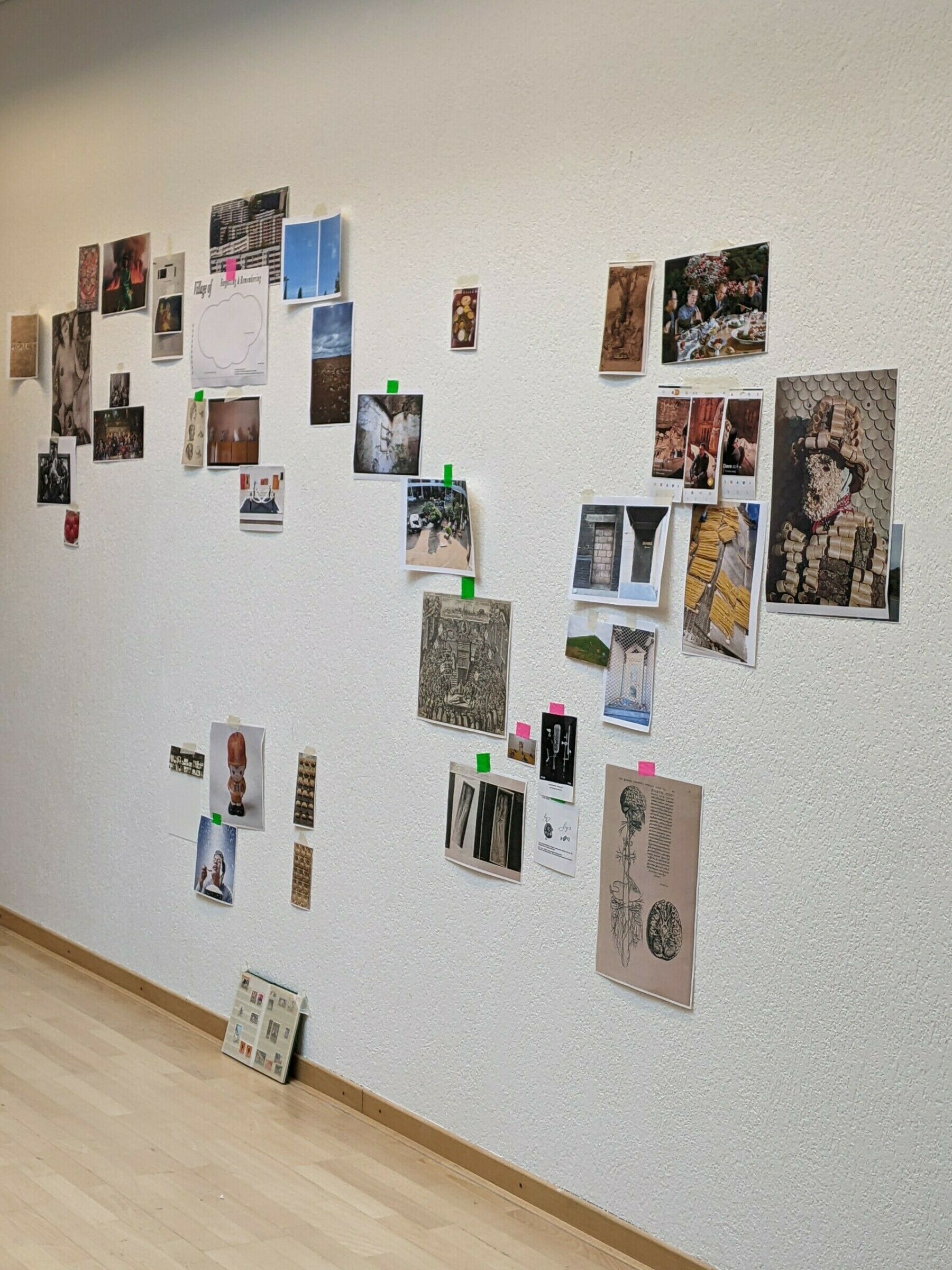
Investigating E/Iconomies at Goethe Institut Rotterdam, curated by Dafni Melidou and Philipp Schwalb. Example of an image constellation.
State and economic power have always spiralled in a toxic relationship, each alternately drowning or pushing the other underwater. Currently, money is clearly taking over the situation(ship). Shoshana Zuboff, author of The Age of Surveillance Capitalism, had warned us already in 2019:
Over the centuries we have imagined threats in the form of state power. This left us wholly unprepared to defend ourselves from new companies with imaginative names run by young geniuses that seemed able to provide us with exactly what we yearn for at little or no cost.Shoshana Zuboff, The Age of Surveillance Capitalism (Profile Books, 2019), 53.
The phoney ‘little or no cost’ mentioned by Zuboff is that of our personal data – from our location to our age to the frequency with which we visit a website, down to any tiny details that could contribute to sharpening our digital doppelganger. But I would argue that the stakes are now even higher. Going back to Leitolf, the social context in which visual knowledge is digitally circulating, for example on Meta’s platforms, allows – is allowing – a very specific kind of discriminatory and violent knowledge to shape our understanding of the world.
Similarly, fake news and clickbait posts are a common communication strategy employed by right-wing groups. I attended a lecture titled ‘Playful Fascism’ where the lecturer, Bram Ieven, presented his research on how current fascisms use the sharing potential of the networked image to amplify information created for the sole purpose of amplification.Bram Ieven ‘Playful Fascism in the Age of Networked Images’, lecture at KABK, The Hague, 28 March 2022. The accuracy of the content in terms of the information it transmits is not important. What counts is the sensational, the ambiguous, and most of all its ad libitum sharing and repetition. If we try to identify a clear agenda behind this techno version of propaganda, one piece of supporting evidence is that amongst those making use of this communication strategy are the current president of the United States and a South African tycoon with the greatest personal wealth ever recorded, whose grip on global politics continues to tighten.
Shedding light on a photograph is not always a bad idea
In such a scenario, what strategies exist to enable us to resist the numbing overflow of pixelated information, to be more aware of the ways that photographs shape our version of the world? If ‘propaganda has become another name for communication itself’,Suhail Malik, ‘Propaganda is Now Another Name for Communication Itself’, interview by Metahaven, PSYOP: An Anthology, eds. Karen Archey and Metahaven (Stedeljik Museum Amsterdam, 2018), 30. maybe the task just feels too vast and overwhelming for a single individual scrolling her feed on her way to work. My suggestion is that we need more collective engagement with photographs. Being confronted with the (photographic) medium in situations where the exchange of ideas is possible might help to shed light on the messages it contains. Engaging with photographs in conversation rather than consuming them alone might confront us with our own biases and assumptions – two factors on which propaganda thrives.
The workshop proposed by my friend at the beginning of this essay was one such move towards a collective reading of photographs. How might it have gone had the students thought together about the content of the violent photograph, instead of just admitting they’d never encountered it before? Perhaps they wouldn’t have guessed its subject, but still, reasoning together on such a charged image might have led them to deeper questions of meaning and interpretation, of the cultural logic encoded in such a casual representation of abuse, of the way the photograph itself – and its distribution – participates in the act of torture, and of our own responsibilities as viewers. Even more, it might have shifted the conversation to the modalities by which this image circulates, simultaneously exploiting and being subjugated by the internet’s amplifying capacities, therefore allowing for visual literacies to enter the debate.
A similar example that tried to slightly expand its borders outside academia was a series of open meetings organised by artist and researcher Dafni Melidou and painter Philipp Schwalb at the Goethe Institut in Rotterdam. Over a series of four encounters between May and December 2023, we discussed different topics related to family and economics. The themes were discussed through the collective viewing of photographs brought in by the participants. One person would start the conversation by picking a photo from the pile and placing it on an empty wall. The others followed, situating their chosen printouts in relation to the ones already taped on the wall. The act of placing generated a discussion in which the meanings of each photograph were analysed from potentially as many points of view as the pairs of eyes participating. From these discussions, a map emerges. The organisers termed this map an ‘image constellation’.
I guess my call here is to approach the photographic medium as something that requires relationality in order to be (more) fully grasped. Yet, in the algorithmic tunnels of the current internet, where each individual is locked into her own small screen and an entire class of students can easily bypass one of the biggest scandals of our time, it might be arduous to imagine how such a practice might look. Melidou and Schwalb give us a good example, and I’d argue that we need to keep organising ourselves in independent and local initiatives and keep carving out spaces where (visual) learning can happen in conversation. I’m rather sure no solutions will come from above, and no resistance to techno-isolation will be mobilised individually.
By activating a practice in which people come together to try resist the isolating speed of digital consumption, a relational approach immediately brings a political dimension to things. Isabelle Stengers said that ‘instead of coming to an agreement, making sense in common is about knowing together that the reasons for resisting, as different as they may be, need each other.’Isabelle Stengers, Making Sense in Common. A Reading of Whitehead in Times of Collapse (University of Minnesota Press, 2023), 17. She’s suggesting that we need each other not despite our differences, but precisely because of them. We need each other, and all our different reasoning and perspectives, to read contested or violent images, as we also need each other to navigate the sometimes overwhelming digital visual abyss. We need each other, writes Stefano Harney in The Undercommons, because to study ‘with and for’ the people in our lives means to depart the institutional pigeonholes and generate, at the grassroots, situations in which learning happens ‘with’ others, instead of being ‘taught from’, and where the study is at the service of a common projectFred Moten and Stefano Harney, Undercommons: Pianificazione Fuggitiva e Studio Nero (Tamu Edizioni, 2021), 238. – and it’s here that I wonder how Stengers’ idea might shape the ways we’ll organise to learn to navigate the large-scale spread of discriminatory and violent imagery.
In my culture, a constellation is made up of many stars looking at each other, and it can only guide us if we can trace all the invisible lines from one to the next. So, too, are photographs: they are constellations of thousands of digital squares or dots of information, each of them carrying the weight of a small world within, and each of them inextricably tied to our gazes, tracing those invisible lines that create meaning from luminous dots.
___
This article forms part of Networking the Audience, a themed online publication guest-edited by Will Boase and Andrea Stultiens, developed in collaboration with MAPS (Master of Photography & Society) at KABK The Hague. The contributions emerge from an open call shared across the MAPS network, including alumni, and bring together artistic and critical perspectives on photography, publishing, and circulation.
Together, the nine contributions reflect on how digital systems reshape authorship, readership, and meaning-making, foregrounding publishing itself as a creative and relational practice. Rather than addressing a fixed audience, the series explores how images and texts move through fluid, networked publics.