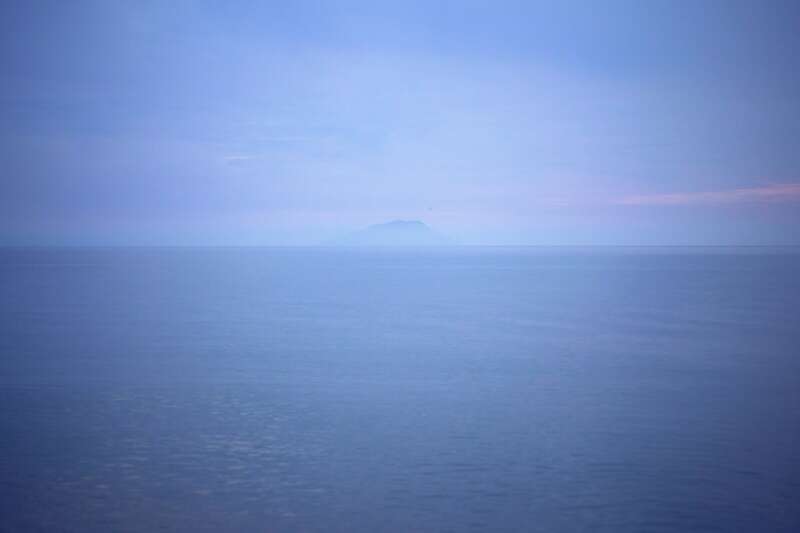
From Kuala Terengganu, Malaysia, Bidong Island appears as a small, heavily forested hill emerging from the sea. Its thick terrestrial trees and lush coral reefs disguise its history as the epicentre of the refugee crisis following the Vietnam War. Underneath the forest canopy lie the graves of refugees, and between coral colonies are sunken ships that refugees once entrusted with their lives. The refugee camp operated from 1978 and hosted tens of thousands of refugees until 1991, when it was officially closed. The intensity of human settlement in the camp destroyed the island’s terrestrial and marine ecosystems. This led the Malaysian government to bar the general public from visiting Bidong after the camp’s closure to allow the island’s terrestrial and marine ecosystems to recover through rewilding efforts. During this period of closure, the University of Malaysia Terengganu, located across the sea from Bidong, established a marine biology research facility on the island where scientists now monitor and study its coral ecology. Also during this period, refugees resettled abroad, built new lives, and began making pilgrimages back to their former island shelter. Public access was officially permitted in 2017.Norhayati Ab Manaf et al., ‘Historic Vietnamese Settlement’, 34.
Flying under the radar
Through a chance encounter at the small regional airport of Kuala Terengganu in March 2026, I met FC, a former refugee who fled the aftermath of the Vietnam War by boating to the crowded refugee camp on Bidong. He stood out among the crowd waiting for luggage at the carousel. Kuala Terengganu is one of the most Muslim regions of Malaysia, so it’s easy to identify who’s from the area and who isn’t. Women wear hijabs while men wear Batik button-up shirts. FC was dressed in all black with cargo pants, a fitted crewneck tee-shirt, a trucker hat, and a backpack with MOLLE attachment points. He spoke on the phone with a thick Texan accent while scanning the carousel for his bags.
At the airport exit, I approached the tactically dressed man. ‘Hey, brother’, I said. ‘Are you American?’
The man suspiciously lifted his angular, blue-tinted, and mirrored sunglasses. ‘Yes.’
‘Are you Vietnamese American?’
‘How did you know? I was trying to fly under the radar.’
‘It’s easy to tell from the way you’re dressed and how you speak.’
‘Aw, shit!’
‘Are you visiting Bidong? I’m an artist who makes work about the island, and my father was a refugee there from 1986 to 1988.’
This began an unlikely friendship with FC. In his teenage years, he was sponsored to relocate from the refugee camp to the United States, where he’s now a naturalised citizen. When he left Bidong, he asked an American humanitarian aid officer, ‘How can I repay my freedom?’ To which the officer replied, ‘By joining the military.’ This began a lifelong link between FC and the US military.
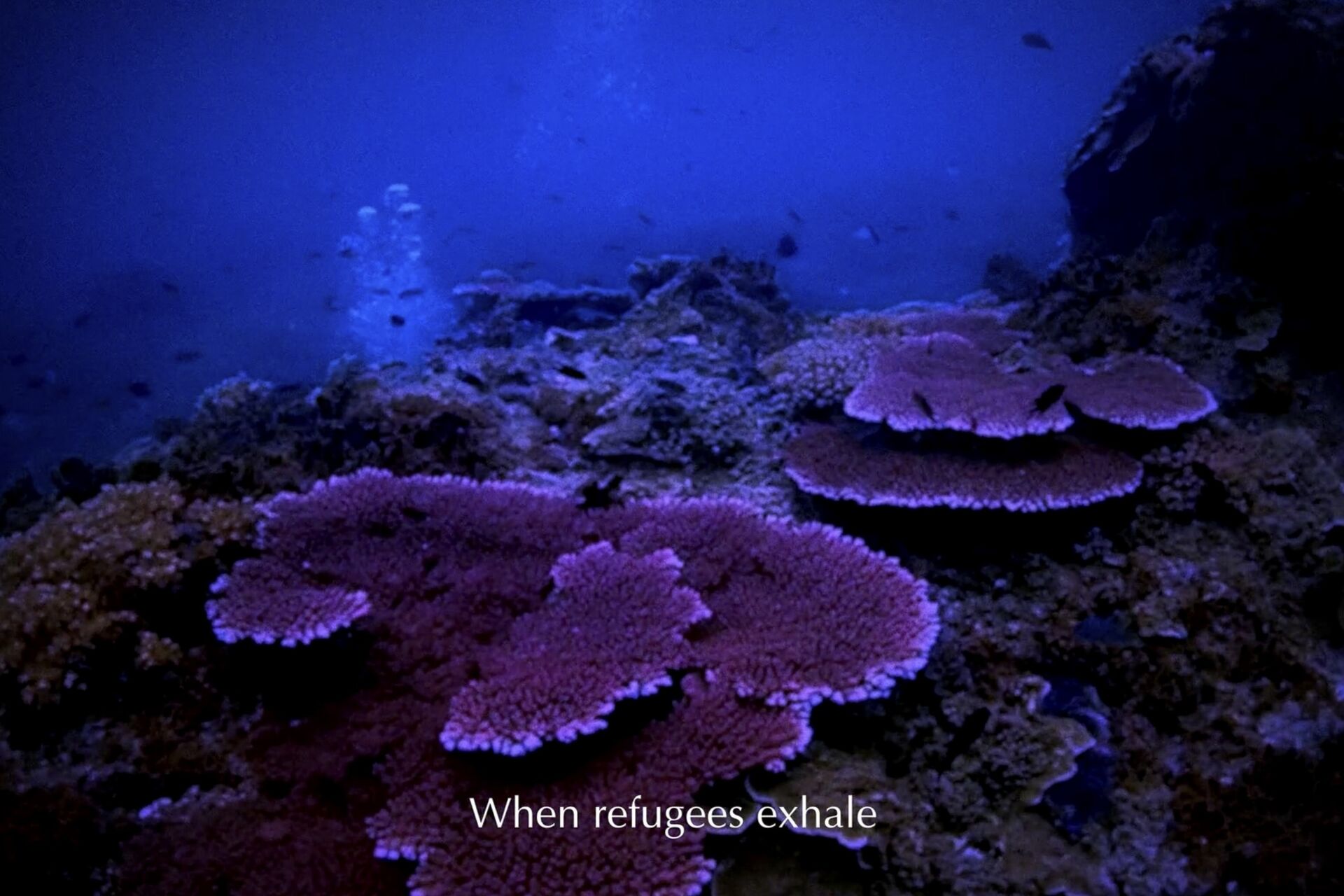
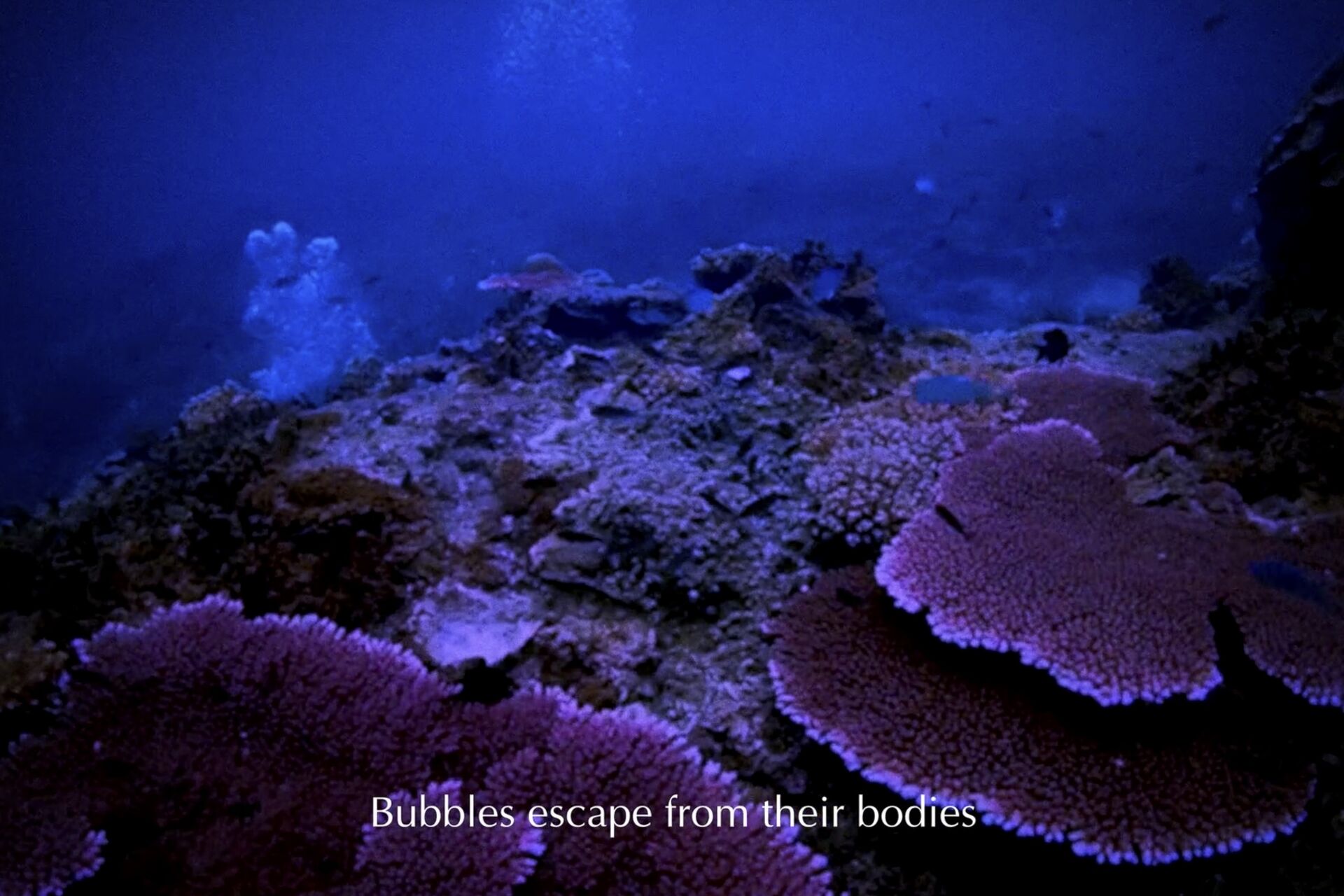
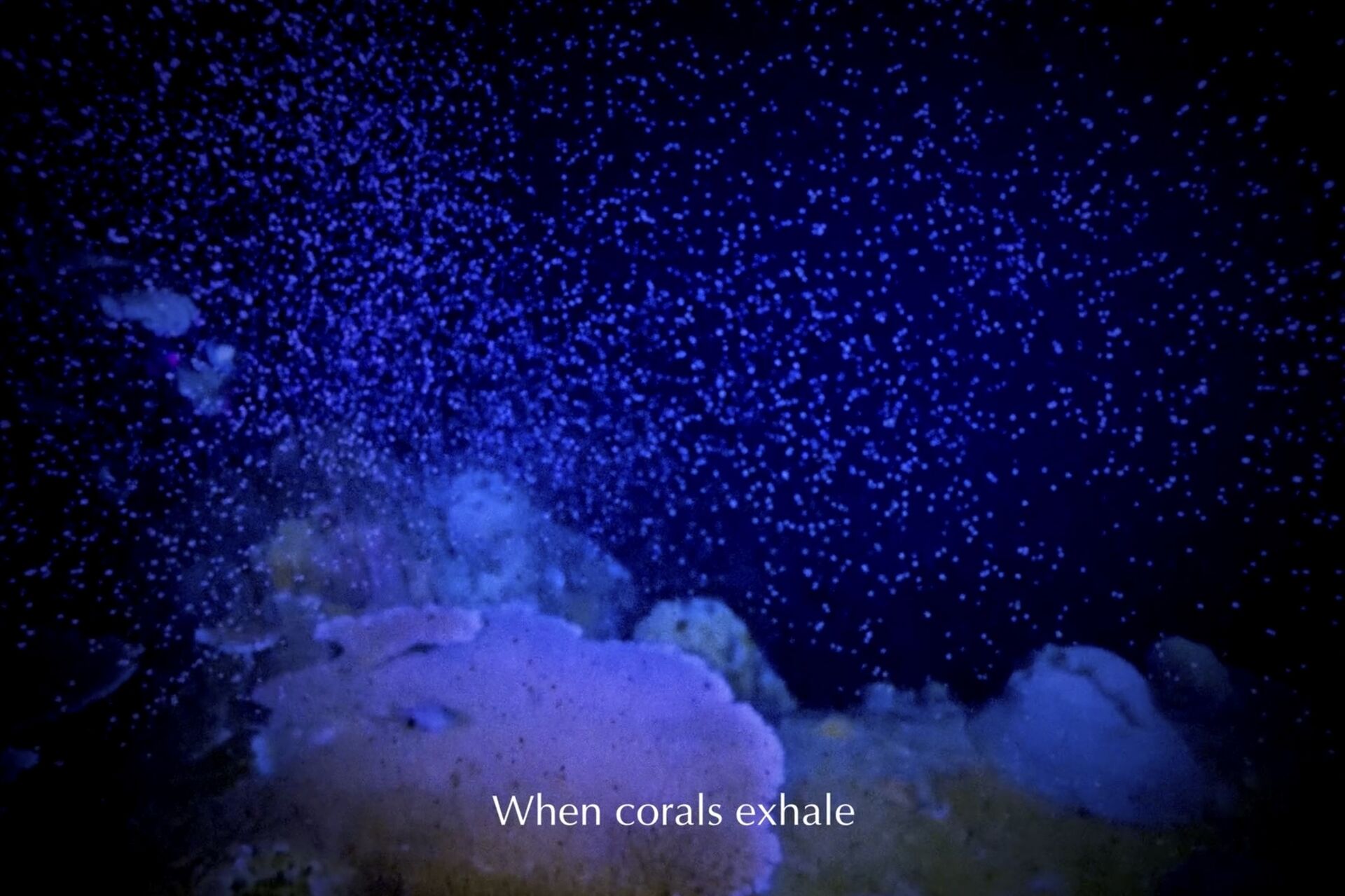
Video stills from Corals of Bidong, 2022–2025.
‘You travel the world to make art, while I travel the world with a gun to shoot people’, he said. ‘In a few years, when I retire, I’ll do what you do, brother.’
FC was set to visit Bidong the next morning, but due to delays with his tour guide, he reached Bidong when the sun began to set. He hiked the footpaths of the island, encountering forest, beach, coral farms, and the graves of refugees. Night had fallen on the island by the time FC embarked on the forty-five-minute boat ride back to Kuala Terengganu.
‘The sea at night is unsettling’, he said. ‘There’s no light. It’s all around. It does something strange to you. I didn’t want to relive my journey. The water scares me now. I didn’t think that returning to the island would be so emotionally intense. I’m still processing it.’
Excursions to Bidong are typically conducted from dawn to noon, when the sea is at its most tranquil, the temperature is cooler, and daylight illuminates. From noon to night, north-easterly winds from the South China Sea blow over the island. The winds push the sea, creating waves and bringing in humidity that condenses into afternoon clouds, releasing sporadic heavy rains in the dry season and relentless downpours during the monsoon season. These currents once sank and carried forward refugees fleeing Vietnam to Peninsular Malaysia.
In the absence of daylight, where boundaries are observable, Bidong’s history revisited FC through physical sensation. What does crossing the sea at night feel like? I imagine there’s no optical boundary between above and below while the rocking of the boat from nightly winds further disorients the senses. Directional references may only come from the growl of boat engines, the battering wind, and the faint city lights of Kuala Terengganu.
On an early April morning, I encountered FC awaiting a taxi to visit the Crystal Mosque of Terengganu. I asked if I could take his photograph in the centre of Kuala Terengganu.
‘Go ahead, brother. Thank you.’
The camera, a Nikon originally released in 1982, while the Vietnamese refugee crisis was unfolding, condensed the humid Terengganu air on its viewfinder and lens. The humidity imposed itself on the image, obscuring parts of the photograph. This foggy vision replicated the climatic phenomena taking place above us as the sky gradually formed clouds by the afternoon.
I returned to Kuala Terengganu to reconnect with marine biologists at the University of Malaysia Terengganu. I wished to share with them my films that they had helped create. In 2025, Professor Hafiz Borkhanuddin invited me to join his class on a research dive below the waters of Bidong. He and his students were studying the different ecological components of the coral ecosystem while I recorded the journey for my films. Now in 2026, we enjoyed a communal lunch held by the marine biology department to celebrate Eid al-Fitr, the ending of Ramadan. In this joyous context, Bidong had become the central pillar for training the next generation of scientists and monitoring the declining biodiversity of the warming sea.
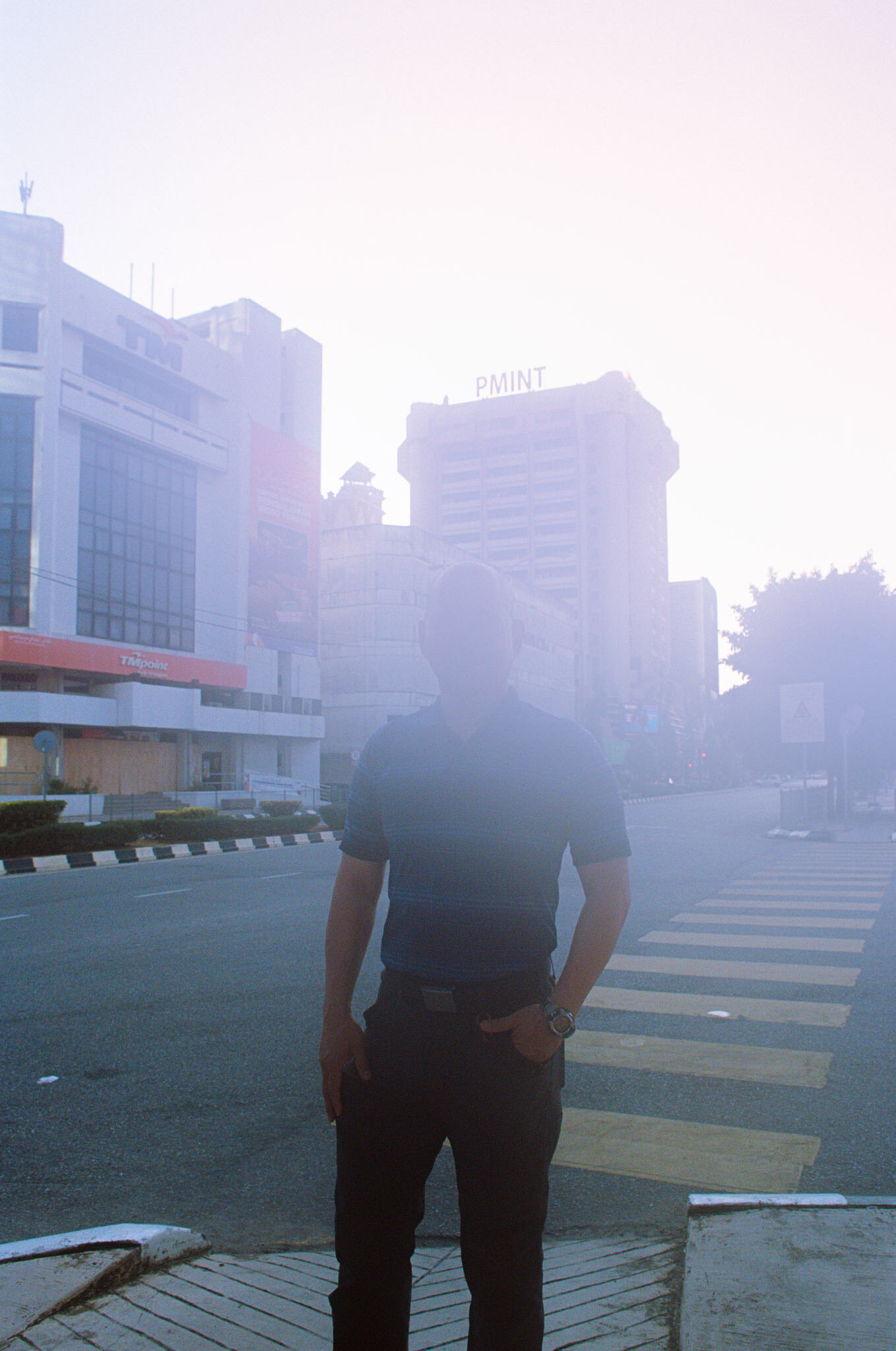
FC, Kuala Terengganu, Malaysia, April 3, 2026.
When I first visited Bidong in 2023, I prepared myself for an emotionally traumatic experience. I’d known little about the island, as my father and his friends seldom shared about life there, perhaps to avoid dwelling on the past. Information that I encountered from this understudied island came from archival news reportage, which was calibrated to articulate the deprivation and urgency of the crisis. My preparation was sidelined when I arrived, as I was instead met with a moving sensation of edification. This sense came from witnessing the recovered terrestrial and marine ecosystems that also obscure the remaining traces of the refugee camp. The graves up the slopes of the island, maintained piecemeal by visiting former refugees, are now overgrown by the forest that also shades stone foundations where camp buildings once stood. The journey revealed the difference between historical accounts of the island and an embodied encounter with its contemporary life. This sensation strengthened when I joined Borkhanuddin and his students. Listening to him teach his eager class allowed me to understand that Bidong had moved on from its dark history. It now faces new challenges from the warming sea. Emerging from the water with his students, Borkhanuddin declared a mass bleaching event had taken place from the unprecedented hot Malaysian summer. Today, another wave of mass deaths is taking place in the waters around the island.
Marine snow
After lunch, Borkhanuddin led me through the university’s collection of marine specimens. Plastic containers held corals and shells, and glass jars of alcohol contained the intact bodies of fish, reptiles, and invertebrates. I wondered if some of the specimens in the collection had metabolised the refugees. In 1979, at the peak of the crisis, approximately 277,000 people had fled Vietnam by boat, and approximately 40 to 70 percent failed to reach land.Laura Madokoro, 'Elusive Refuge: Chinese Migrants in the Cold War' (Harvard University Press, 2017), 191. To date, it’s difficult to determine the number of people who perished at sea over the nearly decade-long refugee crisis. Since 2024, I’ve made frottage drawings at a mass grave in Kuala Terengganu that marks the bodies of at least 397 refugees across six sunken boats.
In the absence of a visible mass of drowned refugees in the sea, I imagine a scene of refugees dissolving in a vast agitated brine. Flesh becomes marine snow that feeds life across the depths, and bones become attachment points for coral on the seafloor. The footage that I’d collected through the help of University of Malaysia Terengganu is used in my films Corals of Bidong (2023-2025), Camp Atlanta (2025), and Dephintely Paradise (2026) to speculate on the absence of the refugee body at sea. The trilogy proposes an alternative to the finality of the refugees’ deaths by imagining their reincarnation into corals below the waters of Bidong.
The first coral farm in Malaysia was established in Bidong in 2014, and it intermittently exports live corals to capital-rich markets in the West, including Germany and the United States. I learned from an infographic at the farm that it made its first commercial shipment in 2016 to Canada,vi where my father was relocated and where I was later born. My film trilogy blends fabulation and documentary to allude to the movement of corals from Bidong to a coral holding facility operated by the United States Customs and Border Protection agency in Atlanta and finally to the Connecticut home of a former refugee who now grows corals as his life’s passion. Through the coral farm, I began to understand the island as a node through which precarious life at sea transits to the West and may later return.
In reopening Bidong in 2017, a strategic aim of the Terengganu state government was to rejuvenate the refugee history for historical tourism.Norhayati Ab Manaf et al., ‘Historic Vietnamese Settlement’, 33. An ambitious development plan from 2019, although since stalled, aimed to recreate two refugee camp structures.viii This included a visitor centre that staged the living conditions of the camp and an office held by the Red Crescent Society.Hazman et al., ‘Sustainable Economic Development’, 25. The plan was to integrate materials collected by the Terengganu State Museum and to restore and clear overgrown burial sites.Hazman et al., ‘Sustainable Economic Development’, 24. A dive shop for recreational deep-water swimming was also in the works.Hazman et al., ‘Sustainable Economic Development’, 25. When completed, these redevelopment plans stand to fundamentally alter the contemporaneity of the island by freezing it in recorded history. All of this could anchor the accounts that made me prepare for a traumatic experience when I first visited the island, which may weaken the potential to witness the healing of the site.
Today, the disappearance of traces of the refugee camp gives rise to conditions in which people enact the upkeep of memory through self-organised and ad hoc means. This allows for the spontaneity of remembrance within the sheer material capacity of the island and sea to absorb and hold the traces of multiple events at once. Such is the case with FC’s passage through a dark island and sea, which evoked the private terror of his former refugee life. This moment is powerful because the past transgresses on the living present. History haunts through the inability to anticipate its arrival.
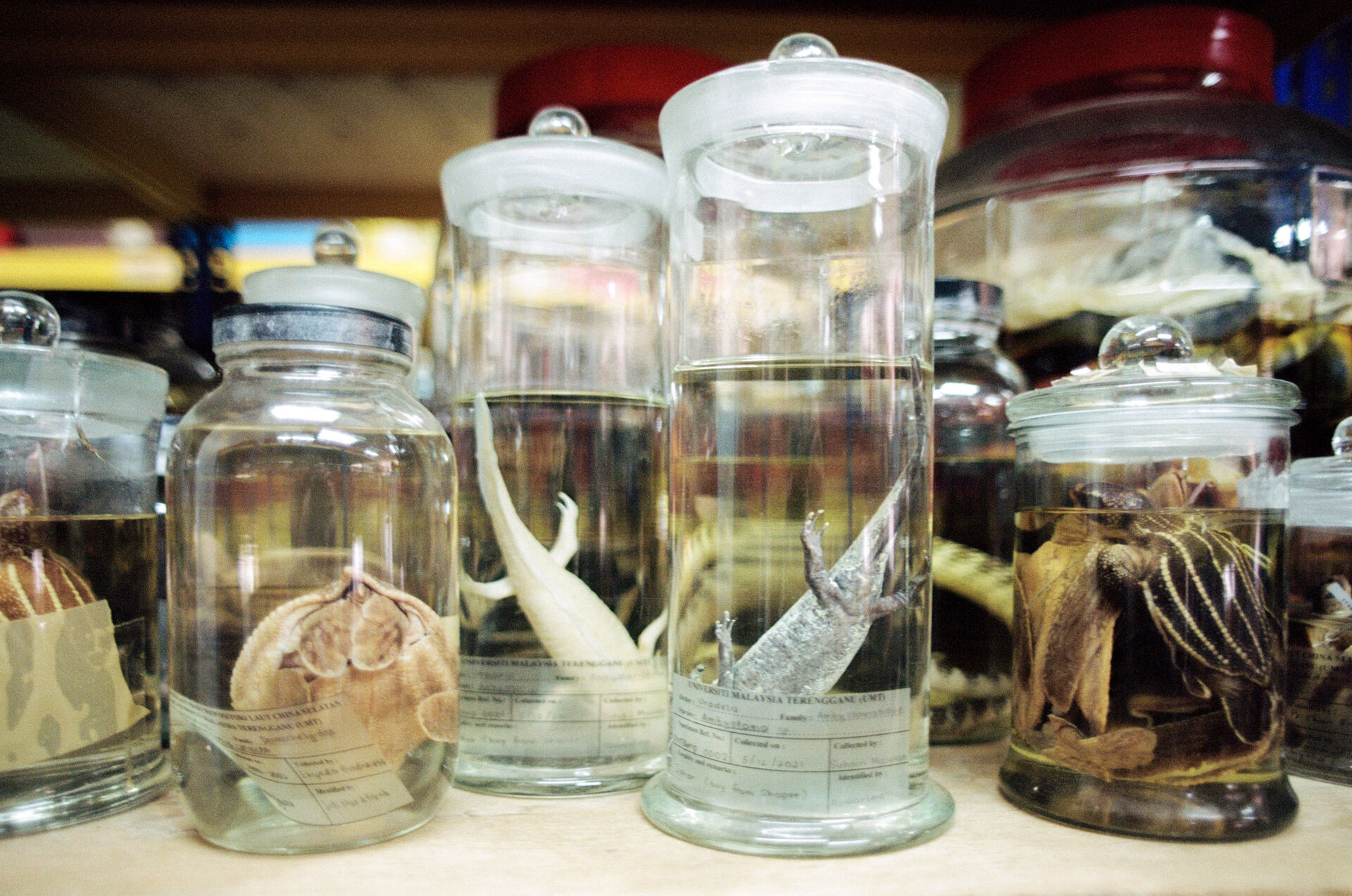
Marine life specimens, University of Malaysia Terengganu, April 2, 2026.
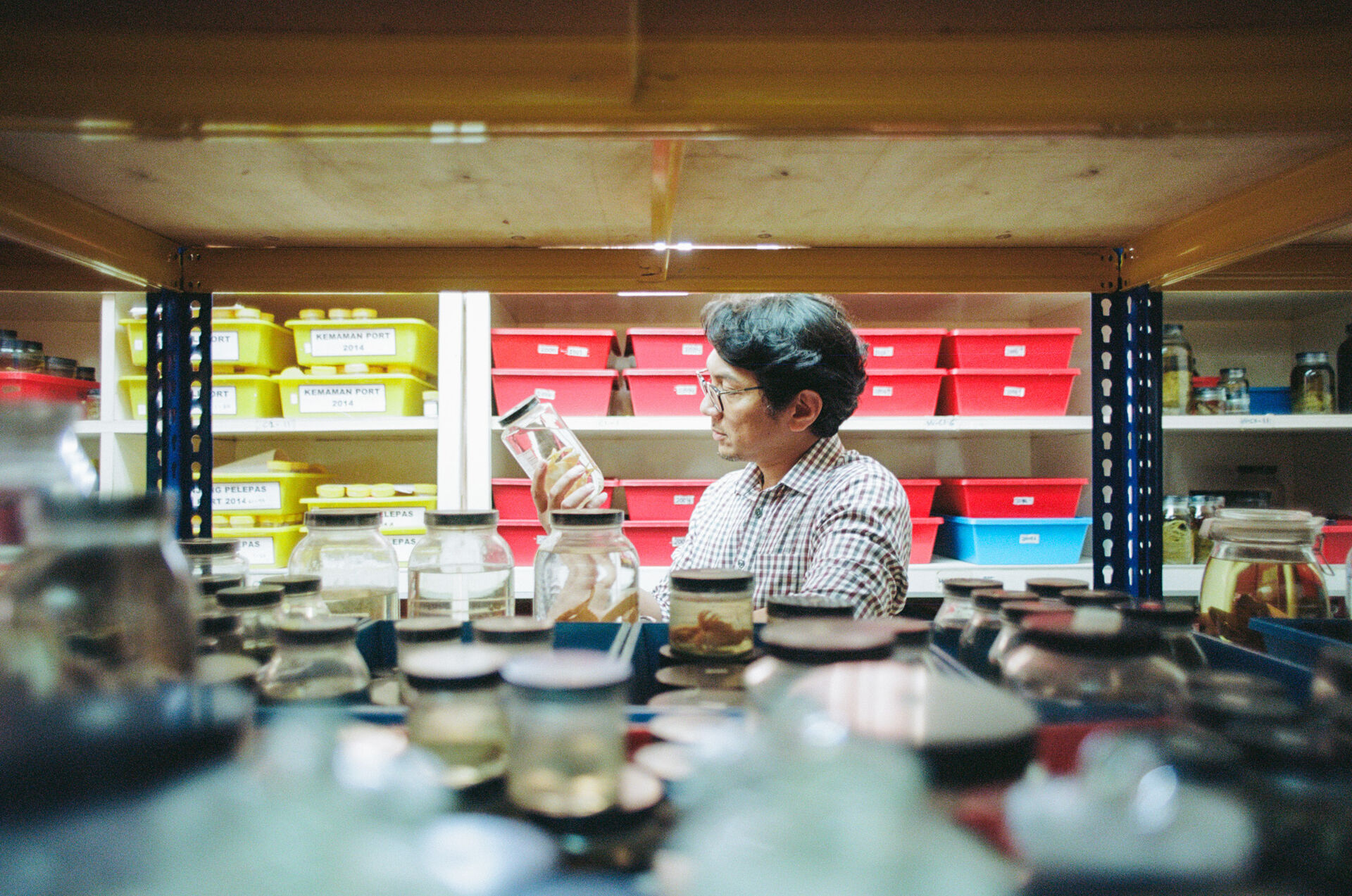
Professor Hafiz Borkhanuddin, University of Malaysia Terengganu, April 2, 2026.
For myself, Bidong was at its most unsettling in retrospect, when I noticed within my collection of research photographs the protrusion of human bones from a crumbling white-painted concrete tomb on the shaded forest floor. The bones were concealed in the live moment among the visual and auditory noise of the forest and the diffused sounds from the shore nearby. The indexicality of the camera, which discards the senses for monocular vision, brought forward the traumatic affect I had initially prescribed to Bidong while ignoring the contemporary life of the island and sea. Indexing, recording, and condensing the island constrains its ever-evolving history.
Bidong is a region that has yet to be historicised. The current ways of remembering mirror the decentralised and aggregated movement of refugees at sea. Here, the past exists in motion among former refugees, marine biologists, a coral farm, the forest, and bleaching corals. I return to the island and sea to understand what I’m part of and who or what else is also there. The porous condition allows for the creation of artworks that attempt to hold and understand the immense human and non-human losses that occurred on the island and the life that’s there now. It allows culture to reshape our understanding of the vast capacity for the sea to absorb life, transforming refugees into the corals that train the next generation of marine biologists and also populate aquariums around the world.
In Dephinitely Paradise, the final film of my trilogy, the former refugee Lan Thieu Nguyen, who’s now a passionate keeper of corals in his quiet Connecticut home, remarked that life on Bidong was paradise. I presented him with a contemporary photograph of a beach in daylight on the island. About the same age as FC, Lan remarked, ‘Yeah, I still remember the water was just crystal clear. The sand was so white. I think it was one of my best memories. Almost like living in paradise.’
This account by Nguyen stands in contrast to the devastation of both the terrestrial and marine ecosystems that the overcrowded and polluted camp had wrought on the island and sea. Yet it also allows the difficult past to exist simultaneously with the present.
---
Sources and further reading
Island history and marine ecology. Norhayati Ab Manaf et al., ‘Historic Vietnamese Settlement of Bidong Island’ (pp. 31–38), and Iqbal Harith Abd. Razak et al., ‘Decapoda Crustaceans at the South China Sea Repository...’ (pp. 61–74), in Bidong Island: Natural History and Resources, ed. Ong Meng Chuan et al. (Springer, 2021). Available via ResearchGate.
Film trilogy and oral history. Alvin Luong, dir., Corals of Bidong (2023–2025), Camp Atlanta (2025), and Dephinitely Paradise (2026). Key local context was provided by Alex Lee, a Kuala Terengganu guide who helped former refugees return to Bidong before its public reopening in 2017 and advised local authorities on site preservation.
Sustainable economic development. Samsudin Hazman, Khatijah Omar, Norhayati Ab Manaf, and Abi Sofian Abd Halim, ‘Sustainable Economic Development of Bidong Island’, in Bidong Island: Natural History and Resources, ed. Ong Meng Chuan et al. (Springer, 2021). Available via ResearchGate.
Geopolitics and memory. Quan Tue Tran, ‘Remembering the Boat People Exodus: A Tale of Two Memorials’, Journal of Vietnamese Studies 7, no. 3 (2012): 80–121. Available via University of California Press. The article explores the geopolitical and ideological tensions between Malaysia, Vietnam, and Vietnamese refugees.
This online contribution is part of Trigger #7: Ocean, the wider project accompanying the printed book published by FOMU and Fw:Books. Extending the book beyond its printed pages, the online series follows further conversations, works and perspectives that explore the ocean as an environment, a force and a way of thinking with images. Each contribution takes its own route through these questions.